 Bug FAQ
Striped Bark Scorpion
Centruroides vittatus · Order: Scorpiones · Family: Buthidae
Also called: Striped Desert Scorpion, Striped Desert Centruroides
Source: Wikipedia, arthropod.uark.edu

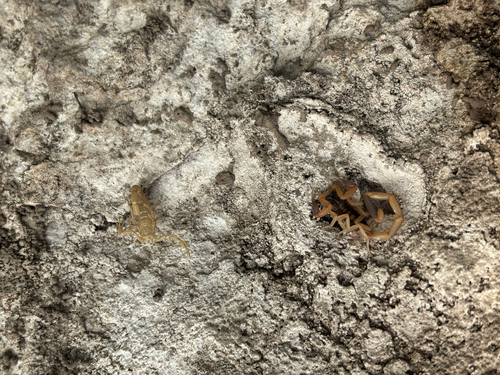
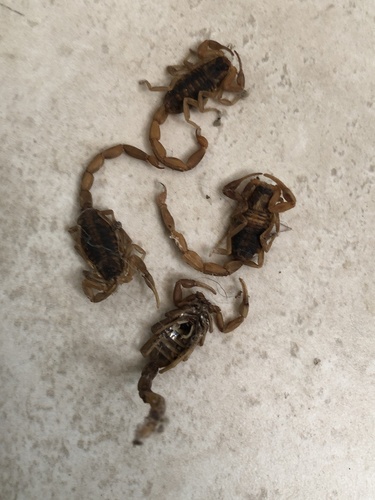
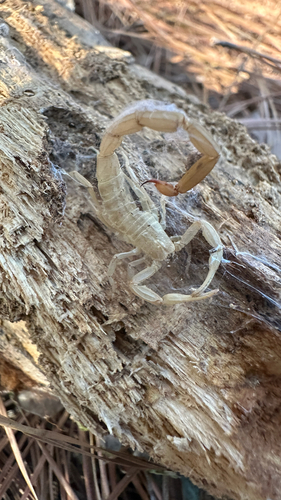
The striped bark scorpion is a pale-yellow scorpion about 2½ inches long with two dark stripes on its back and a black triangle on the head. It lives in crevices under rocks, debris, old structures and houses, emerging at night to hunt insects and other small arthropods. Thousands of people are stung each year, usually when they step on or disturb the scorpions in homes; the sting is painful with swelling but rarely dangerous.
Source: Wikipedia, arthropod.uark.edu
How to recognize it
Uniform pale-yellow color with two dark longitudinal stripes on the carapace and a black triangle above the eyes. The tail tip (stinger) is black, and the rest of the body is yellow-brown. A small tooth is at the base of the curved stinger.
Source: Wikipedia, arthropod.uark.edu
Size
Adults are about 2½ inches (≈70 mm) long, rarely longer.
Source: Wikipedia, arthropod.uark.edu
Is it a pest in the house?
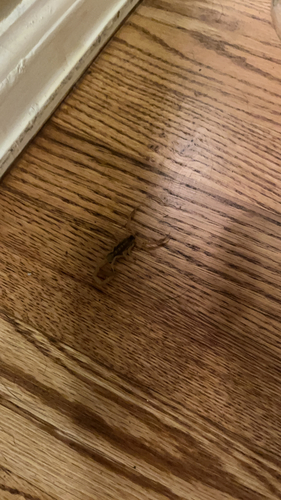
Thousands are stung each year in homes, often when people walk barefoot or turn over wood or rocks. They are active in April-June and often enter houses during this time. They climb trees and plants at night.
Source: Wikipedia, arthropod.uark.edu
Does it bite or sting?
Stings cause immediate sharp pain and local swelling; they are usually of minor medical importance and rarely fatal.
Source: Wikipedia, arthropod.uark.edu
Where it lives
Found in rock crevices, under debris, vegetation, old rural sheds, barns, and houses during the day. At night they leave their shelters and move onto open ground or into vegetation.
Source: Wikipedia
What it eats
Eats insects, smaller arachnids, and even younger scorpions of its own species.
Source: Wikipedia
Life cycle
Females carry live young for about eight months; the newborns stay on the mother’s back for at least one molt. Unlike most scorpions, this species is social, giving it more chances to mate and compete.
Source: Wikipedia
When you see it
Juveniles spend much time in vegetation, likely to avoid predators.
Source: Wikipedia
Where it comes from
Native to the south-central United States and northern Mexico.
Source: Wikipedia
Where it is found in the US
Recorded in 21 of 51 states and DC. Most records: Texas, Oklahoma, Missouri, Colorado, Arkansas, Kansas, New Mexico, Louisiana.
Darker = more records. Counts are museum and citizen-science records, not population size.
Source: GBIF
Status: native in North America; native in United States. Source: iNaturalist
Months it is reported in the US
Source: GBIF
More photos
Questions people ask
What should I do if I get stung by a striped bark scorpion?
Treat the sting with ice and over-the-counter pain relievers; the pain and swelling are usually mild and not serious.
Source: Wikipedia, arthropod.uark.edu
When are striped bark scorpions most active around homes?
They are most active in the spring, especially April to early June, and they often enter houses during this period.
Source: arthropod.uark.edu
How can I identify a striped bark scorpion?
Look for a uniform pale-yellow body with two dark longitudinal stripes on the back and a black triangle on the head; the tail tip is black.
Source: Wikipedia, arthropod.uark.edu
Same family (Buthidae)
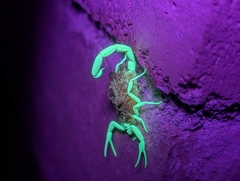 Arizona Bark ScorpionCentruroides sculpturatusVenomous
 Slender Brown ScorpionCentruroides gracilisVenomous
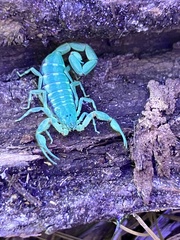 Hentz Striped ScorpionCentruroides hentziCan sting
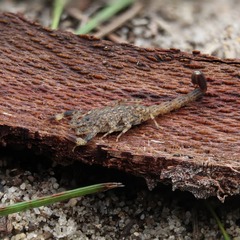 Little Marbled ScorpionLychas marmoreus
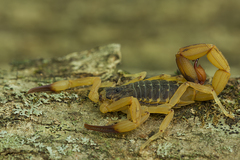 Brazilian Yellow ScorpionTityus serrulatusCan sting
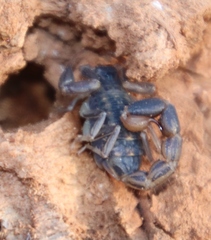 Striped Lesser-Thicktail ScorpionUroplectes lineatusCan sting
Sources
- Wikipedia: https://en.wikipedia.org/wiki/Striped_bark_scorpion
- arthropod.uark.edu: https://arthropod.uark.edu/?p=27095
Look it up elsewhere: GBIF · iNaturalist · BugGuide · Wikipedia
Text written 2026-10-23 from the sources above and checked sentence by sentence against them. Data fetched 2026-10-23.