 Bug FAQ
Tityus fasciolatus
Tityus fasciolatus · Order: Scorpiones · Family: Buthidae
Source: Wikipedia
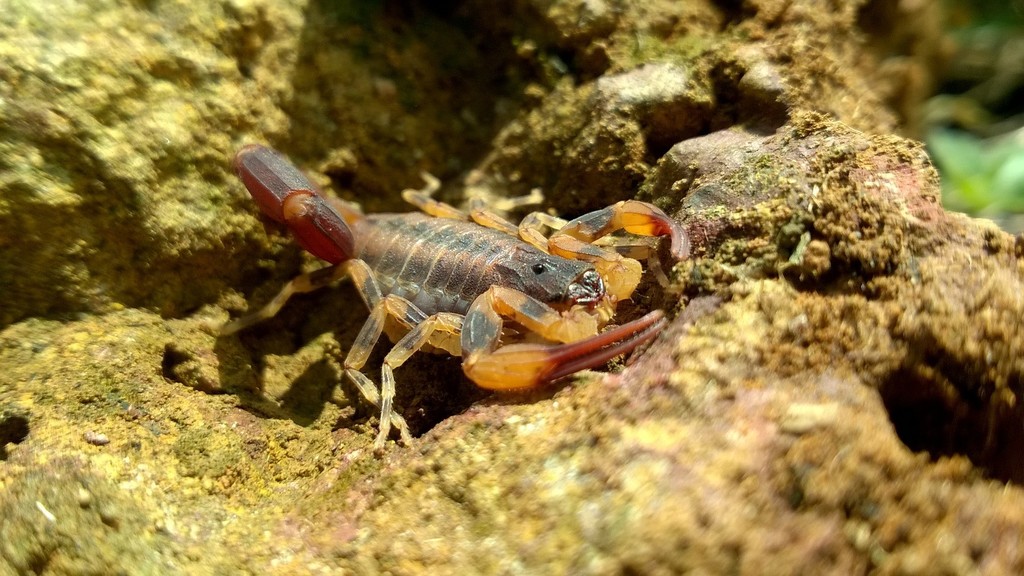
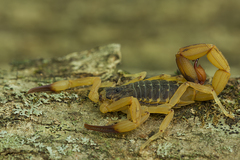
Tityus fasciolatus is a scorpion that can grow up to about 8.5 cm long (1.8 to 3.3 in). It has three dark stripes on its middle body, orange-yellow pedipalps with dark spots, and a metasoma that changes from yellow-orange to reddish and dark red toward the tip. Its venom contains multiple toxic proteins and is considered medically important, with an LD50 of about 3 mg/kg in sub-cutaneous tests.
Source: Wikipedia
How to recognize it
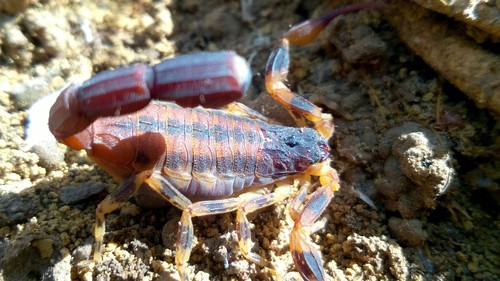
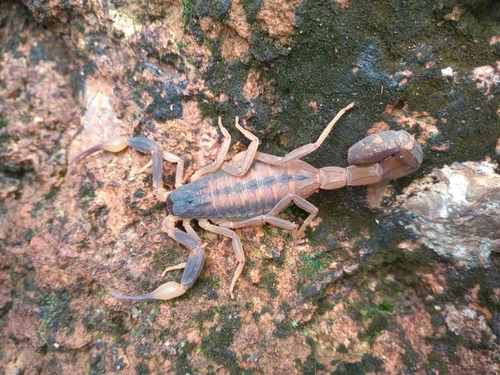
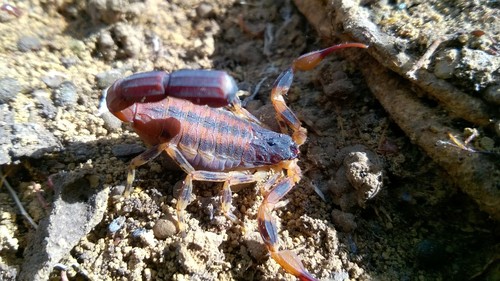
Three dark stripes run over the mesosoma; pedipalps are yellowish or orange with dark spots. The first three metasoma segments are yellow-orange, the fourth is reddish, and the final segment is dark red.
Source: Wikipedia
Size
Adults measure between 4.5 and 8.5 cm (1.8 to 3.3 in) in length.
Source: Wikipedia
Does it bite or sting?
The species is of medical importance; its venom contains at least ten toxic fractions and has an LD50 of 2.984 mg/kg by sub-cutaneous injection.
Source: Wikipedia
Where it lives
It belongs to the scorpion family Buthidae.
Source: Wikipedia
Where it comes from
It is a member of the Buthidae family.
Source: Wikipedia
Lookalikes
Its venom is molecularly very similar to that of T. serrulatus.
Source: Wikipedia
More photos
Questions people ask
How dangerous is a sting from Tityus fasciolatus?
The sting can be medically serious because its venom has multiple toxic components and a low LD50 in tests.
Source: Wikipedia
What does Tityus fasciolatus look like?
It has three dark stripes on the mesosoma, orange-yellow pedipalps with dark spots, and a metasoma that changes from yellow-orange to reddish and dark red at the tip.
Source: Wikipedia
Same family (Buthidae)


Sources
- Wikipedia: https://en.wikipedia.org/wiki/Tityus_fasciolatus
Look it up elsewhere: GBIF · iNaturalist · BugGuide · Wikipedia
Text written 2026-10-23 from the sources above and checked sentence by sentence against them. Data fetched 2026-10-23.