 Bug FAQ
Spotted Woolcarder
Anthidium maculosum · Order: Hymenoptera · Family: Megachilidae

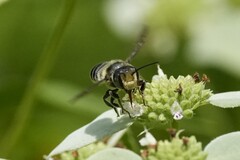
Spotted Woolcarder bees nest in holes they bore in wood and are most common in Mexico and the United States. Males are larger than females, have bigger heads, and territorial males are the biggest individuals.
Source: Wikipedia
How to recognize it
The middle tibia of this bee has a row of spines at its tip.
Source: Wikipedia
Size
Bigger heads go with bigger bodies in this species. Males are larger than females, which is typical for Megachilidae. Territorial males are the largest individuals and hold territories.
Source: Wikipedia
Where it lives
They build nests in holes they excavate in wood.
Source: Wikipedia
What it eats
Females collect pollen and nectar from the mint-like flower Monarda pectinata.
Source: Wikipedia
Life cycle
Females lay eggs continuously throughout the breeding season. The bee develops from egg to larva to pupa inside the brood cell before emerging as an adult.
Source: Wikipedia
When you see it
Adults are most active when flowers are abundant and resources are plentiful.
Source: Wikipedia
Where it comes from
They are native to Mexico and the United States. Their range also includes other parts of Middle and North America.
Source: Wikipedia
Where it is found in the US
Recorded in 11 of 51 states and DC. Most records: Arizona, California, New Mexico, Texas, Utah, Colorado, Oregon, Nevada.
Darker = more records. Counts are museum and citizen-science records, not population size.
Source: GBIF
Status: native in North America; native in United States. Source: iNaturalist
Months it is reported in the US
Source: GBIF
More photos
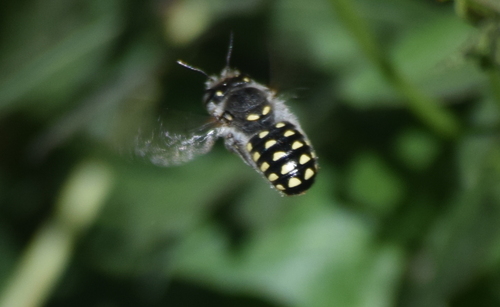
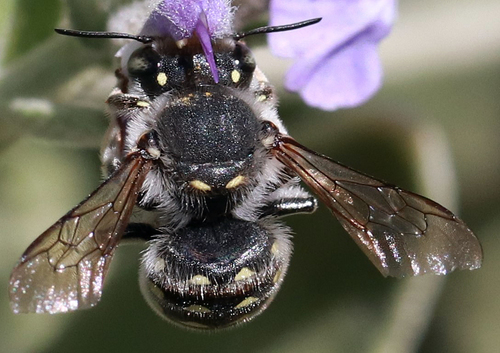
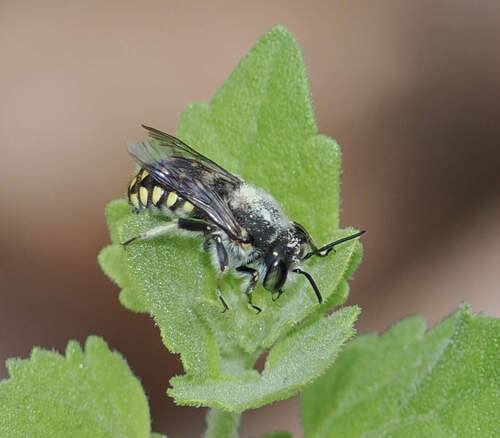
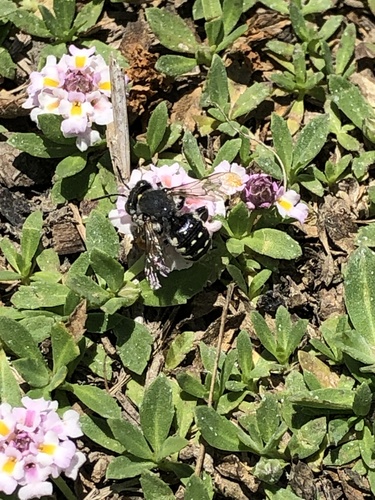
Questions people ask
How can I identify a Spotted Woolcarder bee?
Look for apical spines on the middle tibia and note that males are larger than females.
Source: Wikipedia
When are these bees active?
They are most active during times when many flowers are in bloom, providing plenty of pollen and nectar.
Source: Wikipedia
Where do they build their nests?
They excavate holes in wood and use those cavities as nest sites.
Source: Wikipedia
Same family (Megachilidae)

Sources
- Wikipedia: https://en.wikipedia.org/wiki/Anthidium_maculosum
Look it up elsewhere: GBIF · iNaturalist · BugGuide · ITIS · Wikipedia
Text written 2026-10-23 from the sources above and checked sentence by sentence against them. Data fetched 2026-10-23.