 Bug FAQ
European Orchard Bee
Osmia cornuta · Order: Hymenoptera · Family: Megachilidae
Also called: Mason Bee, White-faced Mason Bee
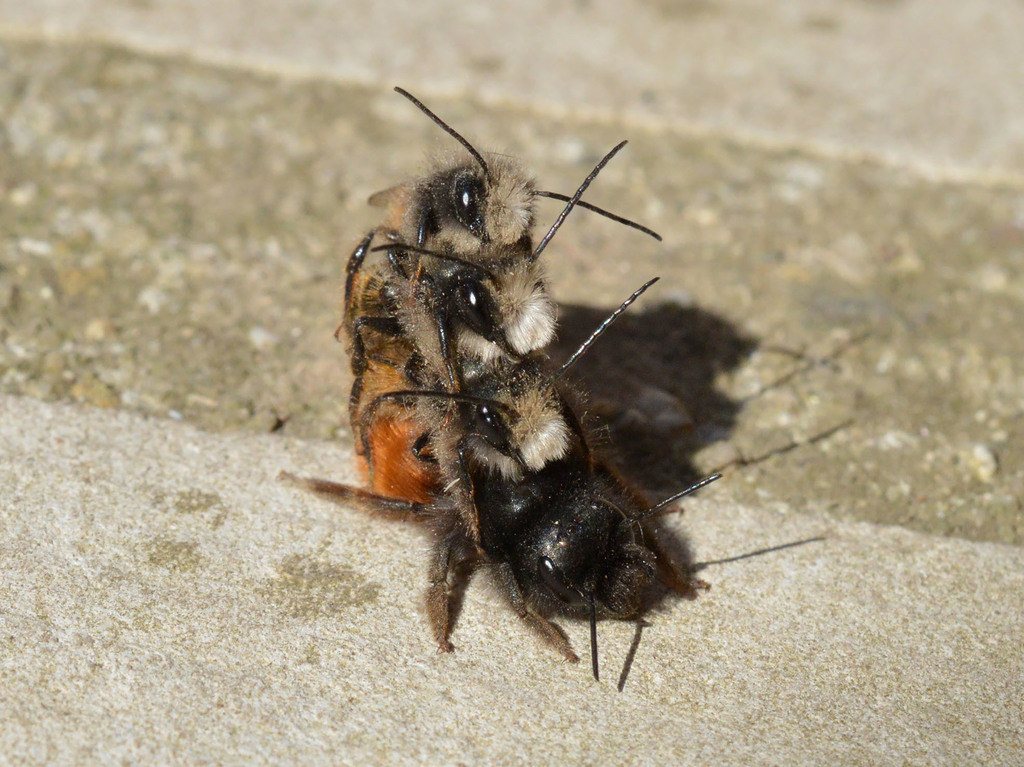
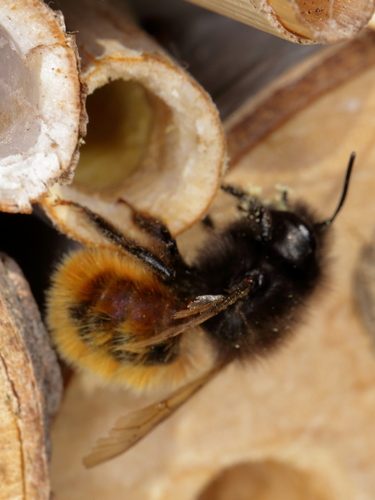
Males have very hairy faces while females show black hair on the head and thorax, a rust-red hairy abdomen and a horned head shield. They live mainly in towns, nesting in large structures such as house walls, cracks in plaster, drainage pipes and old bee nests.
Source: Wikipedia
How to recognize it
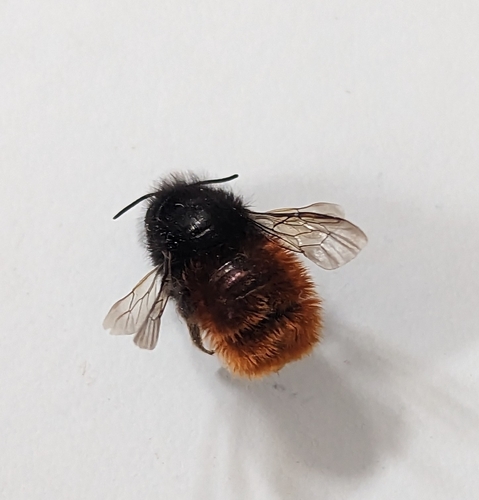
Males have conspicuously hairy faces. Females have black hair on the head and thorax, a rust-red hairy abdomen and a horned head shield.
Source: Wikipedia
Where it lives
The species prefers early, mild springs and is found mainly in settlement areas where early-blooming herbs and trees are abundant. In towns it almost exclusively nests in large structures like house walls.
Source: Wikipedia
What it eats
It feeds on a very wide range of flowers (extremely polylectic). It does not live in colonies; it nests in existing cavities such as cracks in walls, holes in plaster, drainage pipes, window frames, stone recesses and old nests of other bees.
Source: Wikipedia
Life cycle
They overwinter as adults inside a cocoon.
Source: Wikipedia
When you see it
Adults appear from February/March to May/June, with males often showing up by mid-March when Scilla begins to bloom.
Source: Wikipedia
Where it is found in the US
Recorded in 1 of 51 states and DC. Most records: Virginia.
Darker = more records. Counts are museum and citizen-science records, not population size.
Source: GBIF
Status: introduced in Canada. Source: iNaturalist
More photos
Questions people ask
When do European orchard bees appear?
Adults fly from February/March to May/June, and males often show up by mid-March when Scilla blooms.
Source: Wikipedia
Where do they nest in my house?
They use large structures like house walls, cracks in plaster, drainage pipes, window frames and old bee nests.
Source: Wikipedia
How can I tell male and female European orchard bees apart?
Males have very hairy faces, while females have black hair on the head and thorax, a rust-red hairy abdomen and a horned head shield.
Source: Wikipedia
Same family (Megachilidae)

Sources
- Wikipedia: https://en.wikipedia.org/wiki/Osmia_cornuta
Look it up elsewhere: GBIF · iNaturalist · BugGuide · ITIS · Wikipedia
Text written 2026-10-22 from the sources above and checked sentence by sentence against them. Data fetched 2026-10-22.