 Bug FAQ
Smoky-winged Beetle Bandit Wasp
Cerceris fumipennis · Order: Hymenoptera · Family: Crabronidae
Also called: Smokey-winged Beetle Bandit Wasp
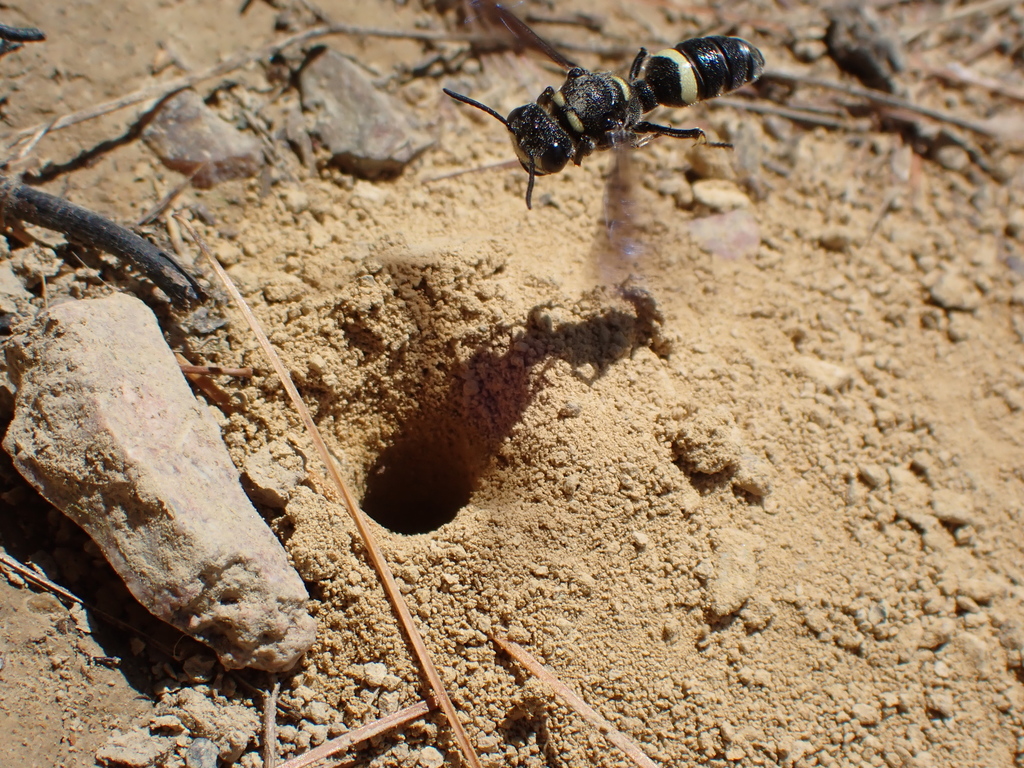
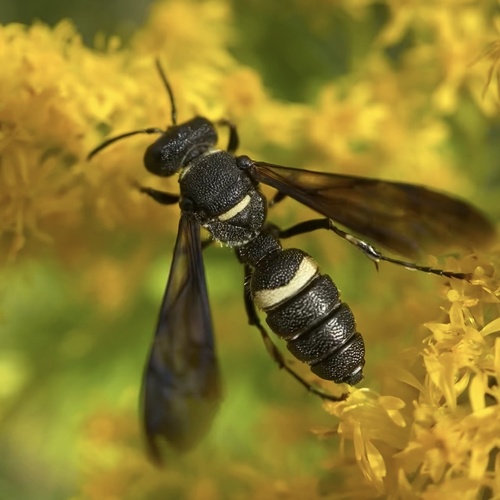
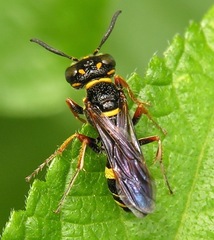
The smoky-winged beetle bandit wasp is about the size of a common yellow jacket and has dark smoky blue-black wings with a single broad creamy yellow band on its abdomen.
Source: Wikipedia
How to recognize it
The body is mostly black with a few yellow markings and a conspicuous creamy yellow abdominal band.
Source: Wikipedia
Size
It is large, roughly the size of common yellow jacket wasps.
Source: Wikipedia
Where it lives
Nests are built in open, hard-packed sandy soil near woody areas that host buprestid beetles. In Ontario, colonies are often found on disturbed, compacted sites such as baseball diamonds, parking lots, roadsides, footpaths, and around campfire pits.
Source: Wikipedia
What it eats
Females stock their nests with beetles from the family Buprestidae. They have been recorded catching emerald ash borer, a pest of ash trees.
Source: Wikipedia
Life cycle
Each female builds and maintains a single underground nest for the whole flight season. In Ontario, the brood cell stage lasts about ten months.
Source: Wikipedia
When you see it
In Ontario, adults are active from the last week of June until early September.
Source: Wikipedia
Where it is found in the US
Recorded in 40 of 51 states and DC. Most records: Massachusetts, Florida, Illinois, New York, Minnesota, Virginia, Texas, Vermont.
Darker = more records. Counts are museum and citizen-science records, not population size.
Source: GBIF
Status: native in North America; native in Canada. Source: iNaturalist
Months it is reported in the US
Source: GBIF
More photos
Questions people ask
Where do these wasps build their nests?
They nest in open, hard-packed sandy soil near woody habitats, often on compacted human-disturbed sites like parking areas or campfire pits.
Source: Wikipedia
Do they help control any pests?
Yes, they collect emerald ash borer beetles, which are a serious ash tree pest.
Source: Wikipedia
When can I expect to see them?
In Ontario they are active from late June through early September.
Source: Wikipedia
Same family (Crabronidae)

Sources
- Wikipedia: https://en.wikipedia.org/wiki/Cerceris_fumipennis
Look it up elsewhere: GBIF · iNaturalist · BugGuide · ITIS · Wikipedia
Text written 2026-10-23 from the sources above and checked sentence by sentence against them. Data fetched 2026-10-22.