 Bug FAQ
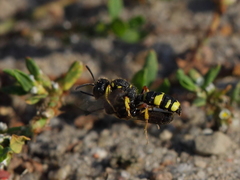
Hump-backed Beewolf
Philanthus gibbosus · Order: Hymenoptera · Family: Crabronidae
Also called: Humped Beewolf
Source: Wikipedia
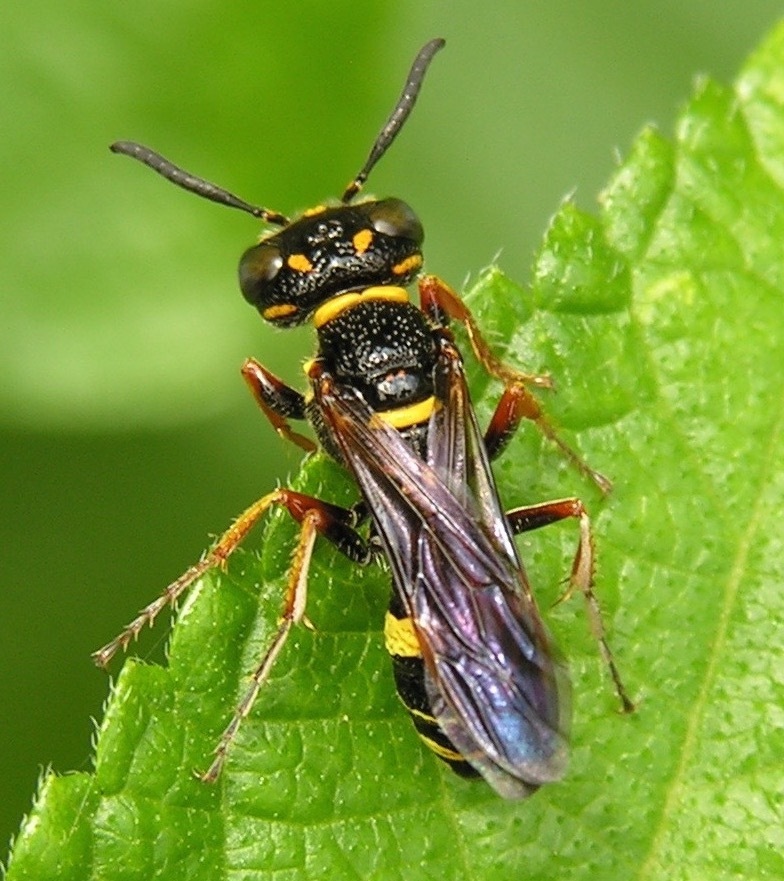
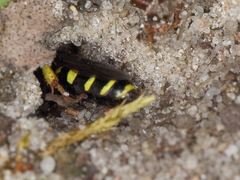
Females hunt bees to provision their carnivorous larvae, while adults sip nectar from flowers; they build nests in sandy soils of coastal or deciduous forest areas in the Midwest and western Appalachians. They produce two generations each year, starting nest building in early June and completing it by early July, after which the females die after about three weeks of egg-laying.
Source: Wikipedia
How to recognize it
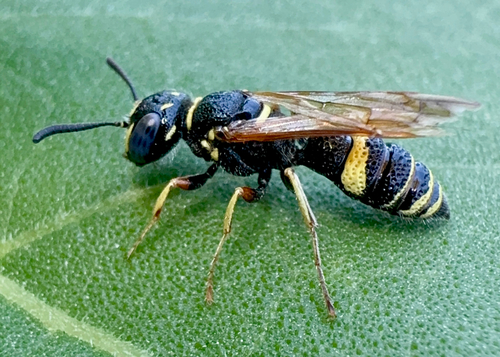
Large, deep punctures on the abdomen make it easy to tell apart from other Philanthus species.
Source: Wikipedia
Size
Adults measure roughly 10 to 12 mm in length, with females usually nearer the smaller end.
Source: Wikipedia
Does it bite or sting?
Its sting is painful and serves to deter most predators.
Source: Wikipedia
Where it lives
It prefers sandy soils in coastal areas and also lives in deciduous forest habitats.
Source: Wikipedia
What it eats
Females hunt bees to feed their carnivorous larvae, while adults feed on flower nectar.
Source: Wikipedia
Life cycle
Two generations are produced each year; females spend about three weeks provisioning nests before dying at season’s end.
Source: Wikipedia
When you see it
Nesting activity begins in the first or second week of June and peaks by early July.
Source: Wikipedia
Where it is found in the US
Recorded in 49 of 51 states and DC. Most records: Massachusetts, New York, Maryland, Virginia, Illinois, Ohio, Minnesota, Pennsylvania.
Darker = more records. Counts are museum and citizen-science records, not population size.
Source: GBIF
Status: native in North America; native in United States. Source: iNaturalist
Months it is reported in the US
Source: GBIF
More photos
Questions people ask
Does the hump-backed beewolf bite or sting?
It can sting, and the sting is painful enough to discourage most predators.
Source: Wikipedia
Where might I find this wasp?
Look for them in sandy coastal soils or deciduous forests in the Midwest and western Appalachians.
Source: Wikipedia
Same family (Crabronidae)

Sources
- Wikipedia: https://en.wikipedia.org/wiki/Philanthus_gibbosus
Look it up elsewhere: GBIF · iNaturalist · BugGuide · ITIS · Wikipedia
Text written 2026-10-22 from the sources above and checked sentence by sentence against them. Data fetched 2026-10-22.