 Bug FAQ
Eastern Cicada-killer Wasp
Sphecius speciosus · Order: Hymenoptera · Family: Crabronidae
Also called: Cicada Killer, Eastern Cicada Killer
Source: Wikipedia, ohioline.osu.edu, hgic.clemson.edu

Eastern cicada-killer wasps are among the largest North American wasps, reaching about 1½ to 2 inches in length with a wingspan near 3 inches. They hunt cicadas, paralyze them, and provision underground nests where their larvae develop, emerging as adults in summer and dying by early fall.
Source: hgic.clemson.edu, Wikipedia
How to recognize it
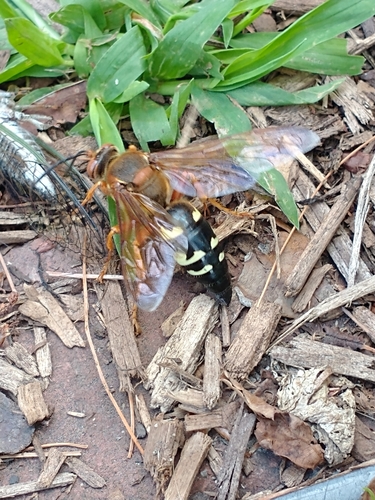
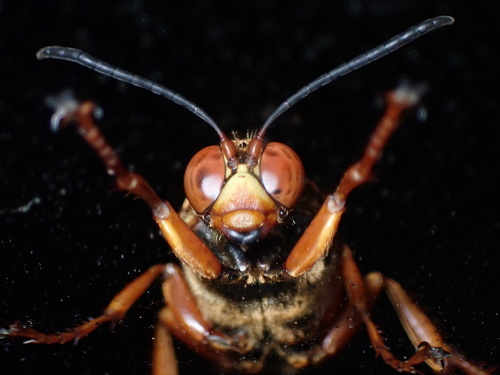
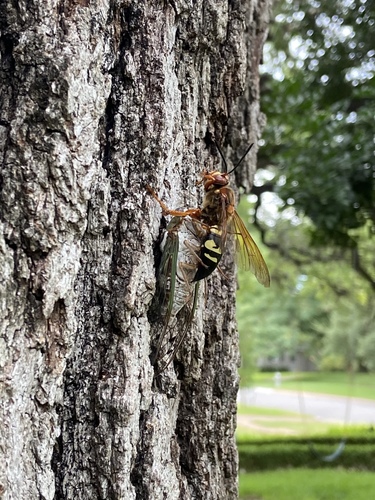
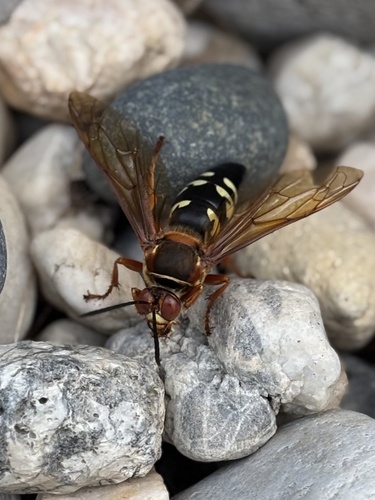
Adults have a black body with yellow-white stripes and a reddish-brown head and thorax, giving them a look similar to large yellowjackets or hornets. Females are slightly larger than males, which contributes to their fearsome appearance.
Source: Wikipedia, ohioline.osu.edu, hgic.clemson.edu, Purdue Extension
Size
They measure from 1.5 cm to 5 cm (0.6 in to 2 in) in length, making them some of the biggest wasps in the eastern United States.
Source: Wikipedia, hgic.clemson.edu
Is it a pest in the house?
They can become a nuisance around high-traffic areas such as swimming pools, golf course greens, and patios, and may leave small mounds of excavated soil. Otherwise they cause little damage to structures or belongings.
Source: ohioline.osu.edu, Purdue Extension
Does it bite or sting?
Females have a functional sting but will only use it if they are grasped roughly, stepped on, or caught in clothing; the sting is usually mild. Males lack a true stinger and may only poke with a pseudo-stinger when defending territory. Because they are solitary, they do not defend nests aggressively and rarely sting unless directly handled.
Source: Wikipedia, ohioline.osu.edu, hgic.clemson.edu, Purdue Extension
How to get rid of it
If control is needed, a small amount of 5 % carbaryl dust can be placed into the nest entrance, or the area can be sprayed for large aggregations. Physical removal by hitting them with a racket or stepping on them as they enter or exit the burrow is also effective. Chemical treatment should be applied during daylight when nests are visible, and local extension offices can provide additional recommendations.
Source: Purdue Extension, ohioline.osu.edu, hgic.clemson.edu
Where it lives
These solitary wasps dig nests in well-drained, sandy or loose-clay soils on bare ground, grassy banks, or near sidewalks and patios.
Source: Wikipedia
What it eats
By hunting cicadas they help control cicada populations, which can benefit deciduous trees that the cicadas feed on.
Source: Wikipedia
Life cycle
One generation occurs each year; the mature larva overwinters in a cocoon underground and pupates in spring for about 25-30 days.
Source: Wikipedia
When you see it
Adults emerge in late June or early July, remain active for 60-75 days, and die off by September or October.
Source: Wikipedia
Where it comes from
They are native to the eastern and mid-western United States and extend south into Mexico and Central America.
Source: Wikipedia
Lookalikes
They are often mistaken for European hornets, yellowjackets, or other large hornets because of their size and coloration. Most wasps seen are males patrolling nesting sites, which can add to the confusion.
Source: Wikipedia, ohioline.osu.edu, Purdue Extension
Where it is found in the US
Recorded in 45 of 51 states and DC. Most records: Texas, New York, Pennsylvania, Illinois, North Carolina, Maryland, Virginia, New Jersey.
Darker = more records. Counts are museum and citizen-science records, not population size.
Source: GBIF
Status: native in North America; native in Canada; native in United States. Source: iNaturalist
Months it is reported in the US
Source: GBIF
More photos
Questions people ask
How large are eastern cicada-killer wasps?
They range from about 1½ to 2 inches long, with a wingspan close to 3 inches, making them among the biggest wasps in North America.
Source: hgic.clemson.edu, Wikipedia
Do they sting people?
Females can sting if handled roughly, but the sting is usually mild and they rarely do so on their own.
Source: Wikipedia, ohioline.osu.edu, hgic.clemson.edu
Are they harmful to trees or gardens?
They actually help trees by reducing cicada numbers, which can benefit deciduous trees that cicadas feed on.
Source: Wikipedia
How can I get rid of a cicada-killer nest?
Apply a small amount of 5 % carbaryl dust into the nest entrance or spray the area for large groups; you can also hit the wasps with a racket or step on them as they enter or leave the burrow.
Source: Purdue Extension, ohioline.osu.edu
Same family (Crabronidae)
Sources
- Wikipedia: https://en.wikipedia.org/wiki/Sphecius_speciosus
- ohioline.osu.edu: https://ohioline.osu.edu/factsheet/ENT-63
- hgic.clemson.edu: https://hgic.clemson.edu/?p=20781
- Purdue Extension: https://www.extension.entm.purdue.edu/publications/E-254/E-254.html
Look it up elsewhere: GBIF · iNaturalist · BugGuide · ITIS · Wikipedia
Text written 2026-10-23 from the sources above and checked sentence by sentence against them. Data fetched 2026-10-23.