 Bug FAQ
Organ-pipe Mud-dauber Wasp
Trypoxylon politum · Order: Hymenoptera · Family: Crabronidae
Also called: Organ-pipe Mud Wasp, Pipe Organ Mud Dauber

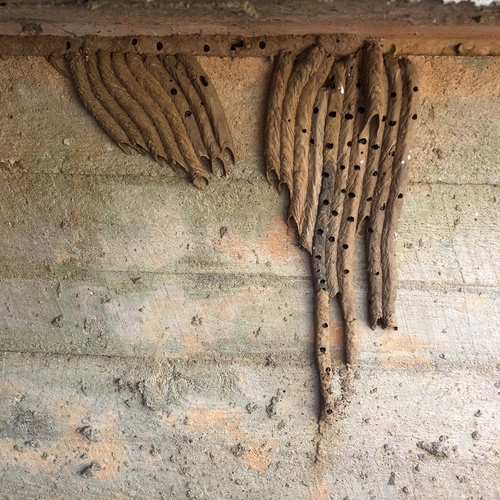
The organ-pipe mud-dauber is a large, shiny black wasp about 4-5 cm long that builds mud nests in tree holes or under bridges. Females stock each mud cell with a paralyzed spider for their larvae, and the adults help keep spider numbers down. It is native to eastern North America and prefers a shaded, vertical surface near mud and forest for nesting.
Source: Wikipedia
How to recognize it
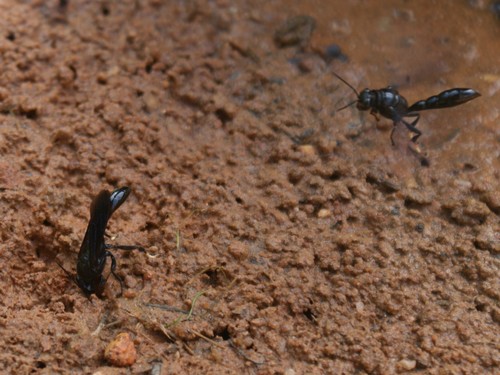
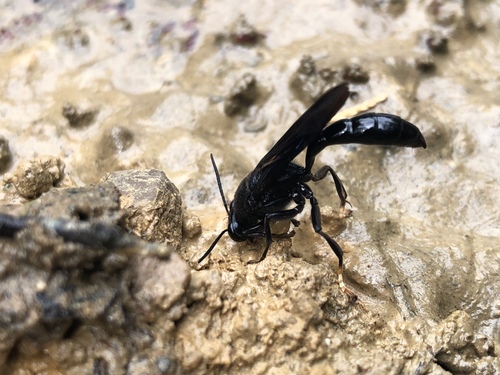
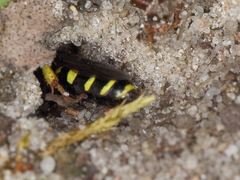
Both sexes are shiny black with the end of the hind leg pale yellow to white.
Source: Wikipedia
Size
Adults measure roughly 3.9 to 5.1 cm in length.
Source: Wikipedia
Does it bite or sting?
They are very docile and rarely sting, but may do so if disturbed while foraging.
How to get rid of it
If control is needed, contact your local mosquito and vector control district or a licensed pest-control operator.
Source: UC IPM
Where it lives
They nest in tree holes or the undersides of bridges, needing a smooth vertical surface with shade, rain protection, nearby mud, and adjacent forest.
Source: Wikipedia
What it eats
Adults hunt spiders, mainly Neoscona, Araneus and Eustala, to provision their mud cells.
Source: Wikipedia
Life cycle
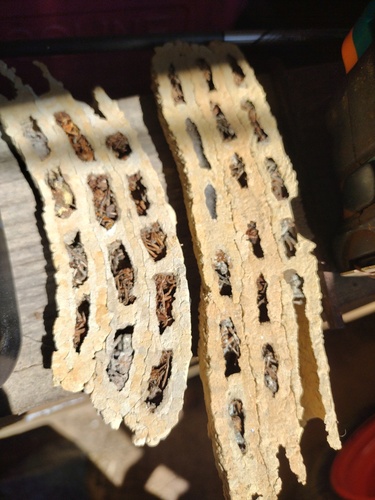
A female lays one egg per mud cell, the larva eats the stored spider, then pupates to become an adult. Newly emerged females start building a new nest within about two days of leaving their birth nest.
Source: Wikipedia
Where it comes from
The species is native to eastern North America.
Source: Wikipedia
Lookalikes
Mud daubers are dark-colored, thread-waisted wasps that build small hard mud nests and are not aggressive.
Source: UC IPM
Where it is found in the US
Recorded in 37 of 51 states and DC. Most records: Texas, Maryland, North Carolina, Virginia, Pennsylvania, New Jersey, New York, Florida.
Darker = more records. Counts are museum and citizen-science records, not population size.
Source: GBIF
Months it is reported in the US
Source: GBIF
More photos
Questions people ask
Do organ-pipe mud-daubers bite or sting?
They are very calm and will only sting if you disturb them while they are hunting.
How can I get rid of them?
Ask your local mosquito and vector control district or a licensed pest-control professional for nest treatment options.
Source: UC IPM
Same family (Crabronidae)

Sources
- Wikipedia: https://en.wikipedia.org/wiki/Organ_pipe_mud_dauber
- UC IPM: https://ipm.ucanr.edu/PMG/PESTNOTES/pn7450.html
Look it up elsewhere: GBIF · iNaturalist · BugGuide · ITIS · Wikipedia
Text written 2026-10-22 from the sources above and checked sentence by sentence against them. Data fetched 2026-10-22.