 Bug FAQ
Red-tailed Mason Bee
Osmia bicolor · Order: Hymenoptera · Family: Megachilidae
Also called: Two Coloured Mason Bee

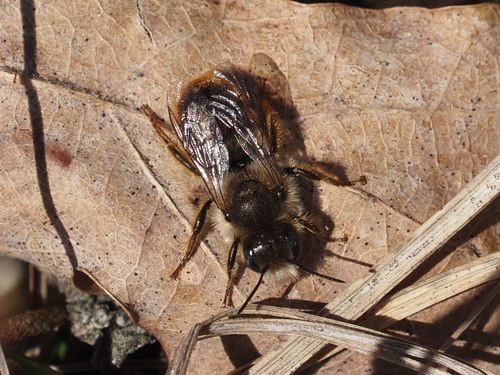
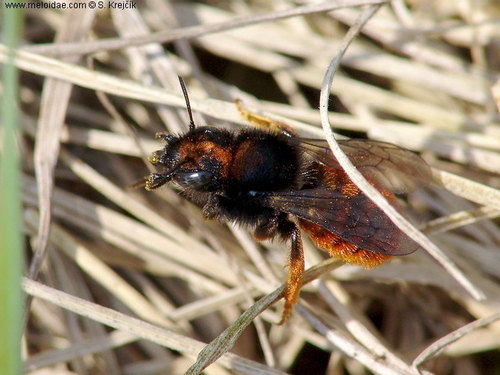
The red-tailed mason bee is a small bee about 12 mm long with a black head and thorax and a bright ginger-coloured abdomen; males have a paler ginger abdomen. It lives in grasslands and open deciduous woodlands on calcareous soils such as limestone or chalk, and females look for empty snail shells to nest in.
Source: Wikipedia
How to recognize it
Females have a black head and thorax and a bright ginger abdomen; males show a less intense ginger colour on the abdomen.
Source: Wikipedia
Size
Females measure about 12 mm in length.
Source: Wikipedia
Where it lives
Females seek out empty snail shells for nesting.
Source: Wikipedia
What it eats
It collects pollen and nectar from many wildflowers and females can be seen carrying loads many times their own length.
Source: Wikipedia
Life cycle
The species has one generation per year in western Europe. Females emerge a few weeks after males, mate quickly, and then begin nesting.
Source: Wikipedia
When you see it
Females emerge a few weeks after males and are quickly mated.
Source: Wikipedia
More photos
Questions people ask
What does the red-tailed mason bee look like?
Females are about 12 mm long, with a black head and thorax and a bright ginger abdomen; males have a paler ginger abdomen.
Source: Wikipedia
Where does this bee live?
It lives in grasslands and open deciduous woodlands on limestone or chalk soils, and females nest in empty snail shells.
Source: Wikipedia
Same family (Megachilidae)

Sources
- Wikipedia: https://en.wikipedia.org/wiki/Osmia_bicolor
Look it up elsewhere: GBIF · iNaturalist · BugGuide · ITIS · Wikipedia
Text written 2026-10-23 from the sources above and checked sentence by sentence against them. Data fetched 2026-10-22.