 Bug FAQ
Painted Grasshopper
Poekilocerus pictus · Order: Orthoptera · Family: Pyrgomorphidae
Source: Wikipedia


The painted grasshopper is a large, brightly coloured insect with yellow, turquoise or blue stripes and red or orange hind wings. Both adults and nymphs feed on poisonous milkweeds and a wide range of other plants, including important agricultural crops, making them a serious pest. Nymphs can eject a milky, foul-smelling liquid up to about 30 cm when disturbed.
Source: Wikipedia
Size
Adults are typically 4.3 to 6.1 cm long.
Source: Wikipedia
Is it a pest in the house?
If food is scarce, they may resort to cannibalism.
Source: Wikipedia
Does it bite or sting?
The defensive spray is pale, milky, slightly viscous, smells unpleasant, and contains cardiac glycosides from their host plants.
Source: Wikipedia
Where it lives
They live in drier regions of India, Pakistan and Afghanistan.
Source: Wikipedia
What it eats
Both life stages feed heavily on poisonous Calotropis milkweeds, acquiring toxins from the plants. They also eat many other plants, including several important crops.
Source: Wikipedia
Life cycle
Nymphs can squirt a jet of noxious liquid up to about 30 cm when grasped.
Source: Wikipedia
Where it comes from
Their native range includes India, Pakistan and Afghanistan.
Source: Wikipedia
Lookalikes
A similar species, Poekilocerus geniplanus, is overall yellowish-brown and was described from Chhattisgarh in 2016.
Source: Wikipedia
More photos


Questions people ask
How large do adult painted grasshoppers get?
Adults are typically between 4.3 and 6.1 cm long.
Source: Wikipedia
Do they damage crops?
Yes, they feed on many agricultural crops and are considered a serious pest.
Source: Wikipedia
Can they spray a liquid when handled?
Nymphs can eject a milky, foul-smelling liquid up to about 30 cm when disturbed.
Source: Wikipedia
Same family (Pyrgomorphidae)
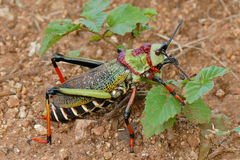 Koppie Foam GrasshopperDictyophorus spumans
 Elegant grasshopperZonocerus elegansDamages trees, gardens or crops
 Northern Grass PyrgomorphAtractomorpha similisDamages trees, gardens or crops
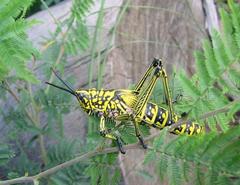 Green Milkweed LocustPhymateus viridipes
 Spotted LocustAularches miliarisDamages trees, gardens or crops
 Variegated grasshopperZonocerus variegatusDamages trees, gardens or crops
Sources
- Wikipedia: https://en.wikipedia.org/wiki/Poekilocerus_pictus
Look it up elsewhere: GBIF · iNaturalist · BugGuide · Wikipedia
Text written 2026-10-23 from the sources above and checked sentence by sentence against them. Data fetched 2026-10-22.