 Bug FAQ
Elegant grasshopper
Zonocerus elegans · Order: Orthoptera · Family: Pyrgomorphidae
Source: Wikipedia

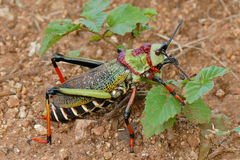
Adults are 3 to 5 cm long, with males being the smaller sex. They have a black head, orange eyes, banded orange-black antennae, an olive pronotum and a starkly banded abdomen. They live in savannahs south of the equator, avoid dense forest and desert, and appear when rains come.
Source: Wikipedia
How to recognize it
The head is mainly black with orange eyes and the antennae sit between the eyes. Antennae show orange and black bands, matching the genus name. The pronotum is olive-coloured and the abdomen has bold contrasting bands.
Source: Wikipedia
Is it a pest in the house?
It can completely strip shrubs of leaves and even debark cassava plants.
Source: Wikipedia
Where it lives
It prefers open savannah habitats and stays away from dense forest and desert areas. It becomes a pest on irrigated crops in these regions.
Source: Wikipedia
What it eats
It feeds on many irrigated crops, defoliating them and damaging stems. It also likes native plants such as Asclepias, Senecio, Solanum and the invasive siam weed.
Source: Wikipedia
Life cycle
Its life cycle is timed to the rainy season.
Source: Wikipedia
Where it is found in the US
Recorded in 1 of 51 states and DC. Most records: Nebraska.
Darker = more records. Counts are museum and citizen-science records, not population size.
Source: GBIF
More photos


Questions people ask
What plants does the elegant grasshopper eat?
It attacks irrigated crops, stripping leaves and damaging stems, and also feeds on native Asclepias, Senecio, Solanum and the invasive siam weed.
Source: Wikipedia
When are they most active?
Their development and activity are synchronized with rainfall, so they appear after rains.
Source: Wikipedia
Same family (Pyrgomorphidae)



Sources
- Wikipedia: https://en.wikipedia.org/wiki/Zonocerus_elegans
Look it up elsewhere: GBIF · iNaturalist · BugGuide · Wikipedia
Text written 2026-10-23 from the sources above and checked sentence by sentence against them. Data fetched 2026-10-22.