 Bug FAQ
Green Milkweed Locust
Phymateus viridipes · Order: Orthoptera · Family: Pyrgomorphidae
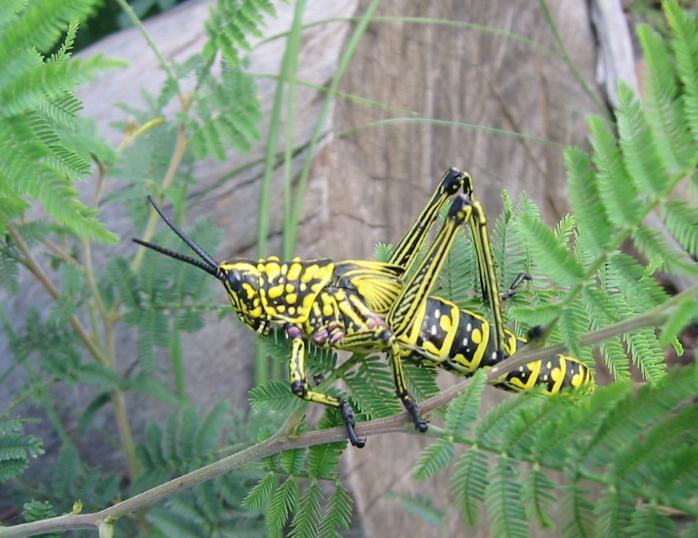
The green milkweed locust grows to about 70 mm (2.8 in) long and can travel long distances. Adults are bright green on the body and fore-wings, with vivid red and blue hind-wings, and a spiny pronotum often tipped in red. They gather in large groups on trees and shrubs, raise their wings when disturbed, and can release a noxious fluid from a thoracic joint.
Source: Wikipedia
How to recognize it
The body and fore-wings are green, while the hind-wings flash bright red and blue in flight. The pronotum behind the head bears spines or carbuncles, often with red tips.
Source: Wikipedia
Size
Mature individuals reach about 70 mm (2.8 in) in length and are capable of long migratory flights.
Source: Wikipedia
Where it lives
When disturbed they raise and rustle their wings and may secrete a noxious fluid from a thoracic joint. They form large congregations on trees and shrubs, arranged to resemble foliage.
Source: Wikipedia
What it eats
Nymphs are bright yellow and black, live in large groups, and eat a variety of plants (polyphagous).
Source: Wikipedia
Life cycle
The nymphs are bright yellow and black, highly gregarious, and feed on many plant species.
Source: Wikipedia
Where it is found in the US
Recorded in 1 of 51 states and DC. Most records: Michigan.
Darker = more records. Counts are museum and citizen-science records, not population size.
Source: GBIF
More photos

Questions people ask
How large does the green milkweed locust get?
It grows to about 70 mm (2.8 in) long at maturity.
Source: Wikipedia
What does this locust look like?
Adults are green on the body and fore-wings, with bright red and blue hind-wings, and a spiny pronotum often tipped in red.
Source: Wikipedia
Where is the green milkweed locust native to?
It is an African species in the family Pyrgomorphidae, known as the African bush grasshopper.
Source: Wikipedia
What plants does it eat?
Adults feed on toxic plants like Acokanthera oppositifolia, Cascabela thevetia and Secamone alpini, while the yellow-black nymphs are polyphagous.
Source: Wikipedia
Same family (Pyrgomorphidae)

Sources
- Wikipedia: https://en.wikipedia.org/wiki/Phymateus_viridipes
Look it up elsewhere: GBIF · iNaturalist · BugGuide · Wikipedia
Text written 2026-10-23 from the sources above and checked sentence by sentence against them. Data fetched 2026-10-22.