 Bug FAQ
Spotted Locust
Aularches miliaris · Order: Orthoptera · Family: Pyrgomorphidae
Source: Wikipedia
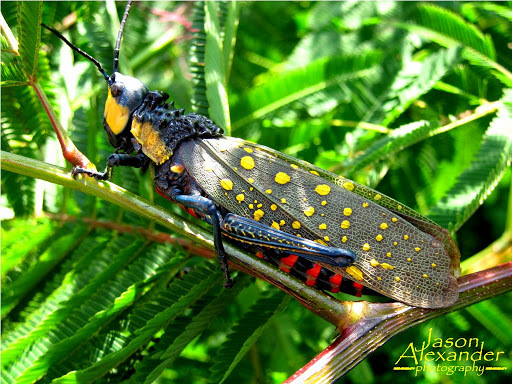
Adults are green with yellow spots and have blue legs with yellow patterns. They gather in October on bushes and grasses and may be controlled by tilling or pesticides. When handled they make a rasping sound and can squirt a smelly, bitter mucus.
Source: Wikipedia
Size
Males measure about 3.7 to 5.5 cm and females about 4.7 to 6.9 cm in length.
Source: Wikipedia
Is it a pest in the house?
They are regarded as agricultural pests, though serious crop damage is uncommon.
Source: Wikipedia
Does it bite or sting?
If disturbed they produce a sharp rasping noise and, when the thorax is squeezed, they eject a clear, smelly, bitter mucus with bubbles.
Source: Wikipedia
How to get rid of it
During high numbers the area can be tilled to destroy egg pods or the insects can be collected. Pesticides work but may harm other animals and plants.
Source: Wikipedia
Where it lives
In October they swarm on bushes and grasses during mating and egg-laying. Large outbreaks that damage crops are rare.
Source: Wikipedia
What it eats
Females lay eggs in the soil, which helps aerate the ground and supports biodiversity.
Source: Wikipedia
Life cycle
Eggs are deposited in the soil and the insects swarm in October to mate and lay more eggs.
Source: Wikipedia
When you see it
Swarming occurs in October, the main mating and egg-laying period.
Source: Wikipedia
Where it comes from
It is native to South and Southeast Asia.
Source: Wikipedia
Lookalikes
People often mistake them for the plague-causing locust species.
Source: Wikipedia
Questions people ask
What does the spotted locust look like?
It has a dark-green head and thorax with a yellow side band, green wings dotted with yellow spots, and blue legs marked with yellow on the hind femora.
Source: Wikipedia
When are they most likely to appear?
Large groups appear in October when they swarm to mate and lay eggs.
Source: Wikipedia
How can I get rid of them?
You can till the soil to destroy their egg pods, collect the insects, or use pesticides, keeping in mind that chemicals may affect other wildlife.
Source: Wikipedia
Same family (Pyrgomorphidae)
Sources
- Wikipedia: https://en.wikipedia.org/wiki/Aularches
Look it up elsewhere: GBIF · iNaturalist · BugGuide · Wikipedia
Text written 2026-10-23 from the sources above and checked sentence by sentence against them. Data fetched 2026-10-23.