 Bug FAQ
Orchid Dupe Wasp
Lissopimpla excelsa · Order: Hymenoptera · Family: Ichneumonidae
Also called: Dusky-winged Ichneumonid Wasp

The orchid dupe wasp has a red-brown head, mesosoma, legs and the tip of its abdomen, while the first four abdominal segments are black with large white spots; its wings are smoky brown except at the fore-wing tips. It is found in New Zealand, likely introduced there, and may also be native to that country. The wasp is a parasite that attacks other insects, including the crop pest moth Helicoverpa armigera.
Source: Wikipedia
How to recognize it
Head, mesosoma, legs and the end of the abdomen are red-brown; the first four abdominal segments are black with paired large white spots; wings are dark smoky brown with lighter tips on the fore-wings.
Source: Wikipedia
Where it lives
It occurs in New Zealand, where it is called the dusky-winged ichneumonid, and is probably an introduced species.
Source: Wikipedia
What it eats
Like other members of its family, it is parasitic. It parasitises the noctuid moth pest Helicoverpa armigera.
Source: Wikipedia
Where it comes from
Some sources suggest the species may be native to New Zealand.
Source: Wikipedia
Lookalikes
It was formerly known as Lissopimpla semipunctata, but the name Lissopimpla excelsa has priority.
Source: Wikipedia
More photos


Questions people ask
What does the orchid dupe wasp look like?
It has a red-brown head, mesosoma, legs and tip of the abdomen, black front abdominal segments with large white spots, and smoky brown wings with lighter fore-wing tips.
Source: Wikipedia
Where is this wasp found?
It is present in New Zealand, likely as an introduced species, and some sources say it may be native there.
Source: Wikipedia
What does the orchid dupe wasp prey on?
It is a parasitic wasp that attacks other insects, including the crop pest moth Helicoverpa armigera.
Source: Wikipedia
Has the species had other scientific names?
Yes, it was once called Lissopimpla semipunctata, but Lissopimpla excelsa is the correct name.
Source: Wikipedia
Same family (Ichneumonidae)
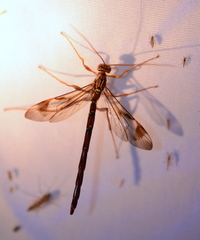 Long-tailed Giant Ichneumonid WaspMegarhyssa macruraHarmless
 Common Hover Fly Parasitoid WaspDiplazon laetatorius
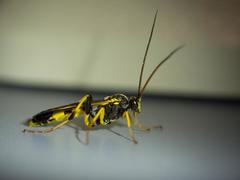 Toothed Tiger IchneumonAmblyteles armatorius
 Black Giant Ichneumonid WaspMegarhyssa atrata
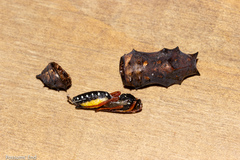 Cream-spotted IchneumonEchthromorpha intricatoriaHarmless
 Black-tipped Orange Ichneumon WaspCtenochares bicolorus
Sources
- Wikipedia: https://en.wikipedia.org/wiki/Lissopimpla_excelsa
Look it up elsewhere: GBIF · iNaturalist · BugGuide · Wikipedia
Text written 2026-10-23 from the sources above and checked sentence by sentence against them. Data fetched 2026-10-22.