 Bug FAQ
Long-tailed Giant Ichneumonid Wasp
Megarhyssa macrura · Order: Hymenoptera · Family: Ichneumonidae
Source: Wikipedia
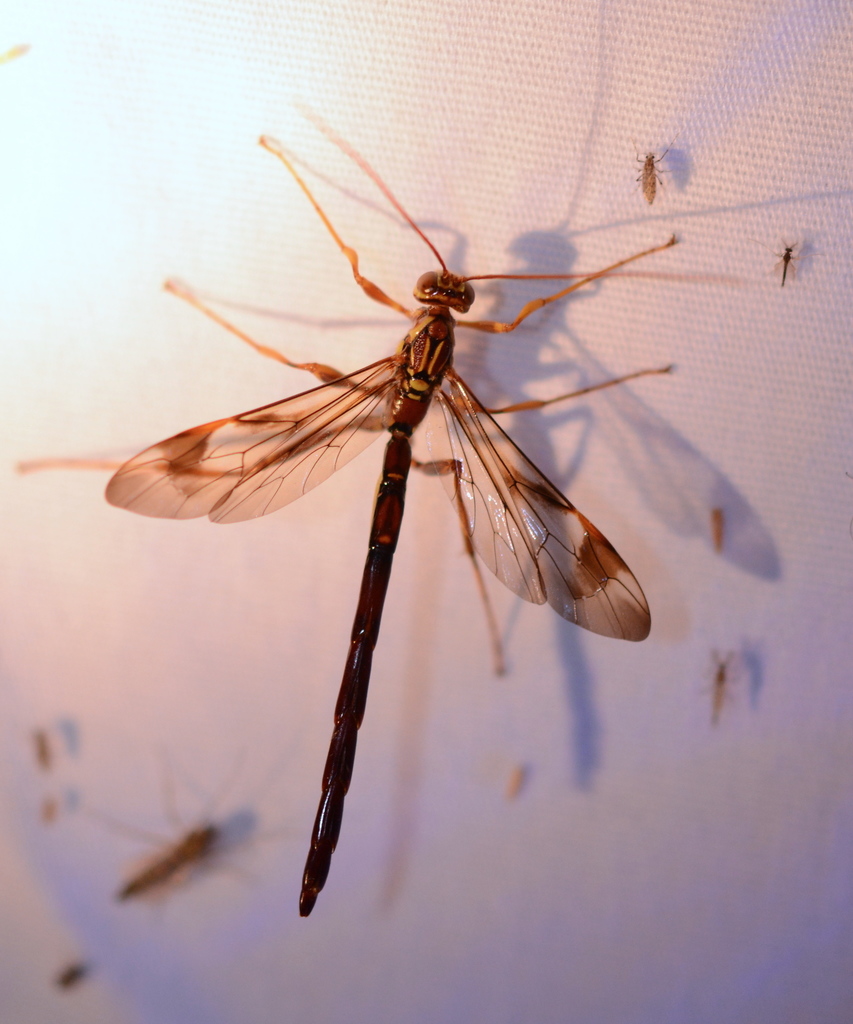
The long-tailed giant ichneumonid wasp has a reddish-brown body up to 2 inches long with black and yellow-orange stripes and transparent wings. Females have an ovipositor that extends the total length to more than 5 inches, which they use to locate and paralyze wood-boring horntail larvae before laying eggs on them. The wasp is found across the eastern United States and into the southern part of Canada near the Great Lakes and does not bite or sting people.
Source: Wikipedia
How to recognize it
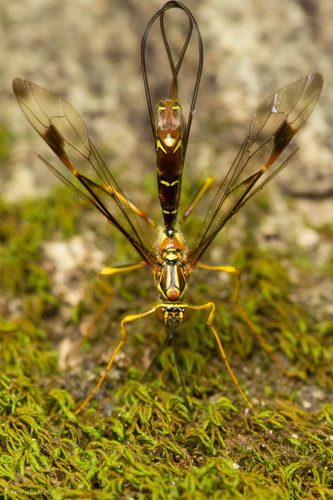
It displays black and yellow-orange stripes on its elongated body and has clear, transparent wings.
Source: Wikipedia
Size
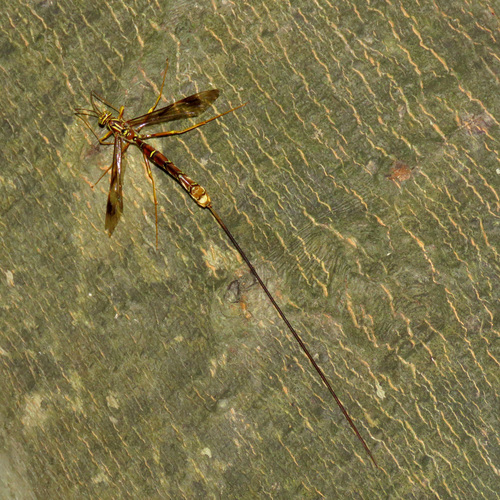
The body can reach up to 2 inches (51 mm) in length. In females, the ovipositor adds enough length that the whole insect can be over 5 inches (130 mm) long.
Source: Wikipedia
Does it bite or sting?
The ovipositor is a very thin tube that guides the egg down a minute channel as it is laid.
Source: Wikipedia
What it eats
Females detect horntail larvae inside bark, paralyze them, and lay eggs on the living but immobilized host.
Source: Wikipedia
Life cycle
The wasp larvae consume the host within weeks, pupate, and emerge as adults the following summer.
Source: Wikipedia
When you see it
The species is harmless to humans.
Source: Wikipedia
Where it comes from
Its native range covers the eastern United States and the southern edge of Canada around the Great Lakes.
Source: Wikipedia
Where it is found in the US
Recorded in 47 of 51 states and DC. Most records: Ohio, Illinois, Michigan, Texas, New York, Colorado, Utah, Massachusetts.
Darker = more records. Counts are museum and citizen-science records, not population size.
Source: GBIF
Months it is reported in the US
Source: GBIF
More photos

Questions people ask
What does this wasp look like?
It has a reddish-brown, elongated body with black and yellow-orange stripes and clear wings, and females can be over 5 inches long because of their long ovipositor.
Source: Wikipedia
What does it feed on?
Females hunt horntail larvae inside wood, paralyze them, and lay eggs on the living host.
Source: Wikipedia
Where can I find this wasp?
It occurs across the eastern United States and into the southern part of Canada near the Great Lakes.
Source: Wikipedia
Same family (Ichneumonidae)




Sources
- Wikipedia: https://en.wikipedia.org/wiki/Megarhyssa_macrurus
Look it up elsewhere: GBIF · iNaturalist · BugGuide · Wikipedia
Text written 2026-10-23 from the sources above and checked sentence by sentence against them. Data fetched 2026-10-23.