 Bug FAQ
Oleander Aphid
Aphis nerii · Order: Hemiptera · Family: Aphididae
Source: Wikipedia

The oleander aphid lives in warm tropical and Mediterranean areas and has been found in a Polish glasshouse. It mainly feeds on dogbane family plants but will also use bindweed, daisy, spurge and occasionally citrus. Females give birth to live nymphs and reproduce without mating.
Source: Wikipedia
Where it lives
It is common in regions with tropical and Mediterranean climates. In Poland it has only been recorded inside a glasshouse.
Source: Wikipedia
What it eats
It is also found on bindweed, daisy, spurge and rarely on citrus.
Source: Wikipedia
Life cycle
Females give birth to live young (nymphs). Reproduction occurs by parthenogenesis, so no males are needed.
Source: Wikipedia
Where it is found in the US
Recorded in 50 of 51 states and DC. Most records: California, Texas, New York, Massachusetts, Pennsylvania, Illinois, Ohio, Virginia.
Darker = more records. Counts are museum and citizen-science records, not population size.
Source: GBIF
Status: introduced in North America; introduced in United States. Source: iNaturalist
Months it is reported in the US
Source: GBIF
More photos


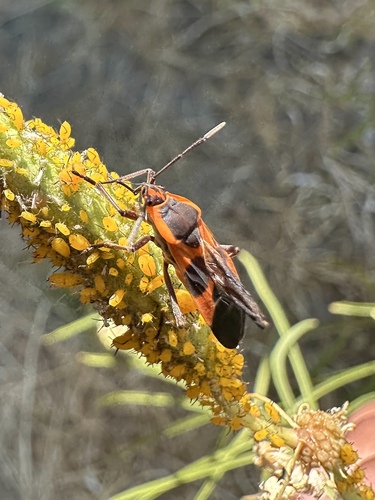
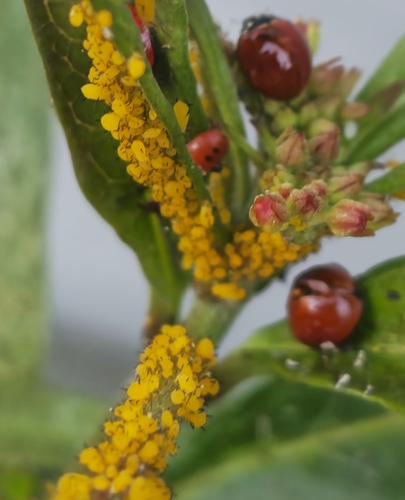
Questions people ask
What plants do they damage?
They mainly damage ornamental plants in the dogbane family, like oleander, milkweed and periwinkle, and can also affect bindweed, daisy, spurge and occasionally citrus.
Source: Wikipedia
Where might I find them in a cooler climate?
In cooler regions they are usually only found inside heated glasshouses.
Source: Wikipedia
Same family (Aphididae)
 Melon AphidAphis gossypiiDamages trees, gardens or crops
 Witch-hazel Cone Gall AphidHormaphis hamamelidis
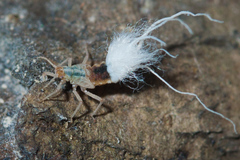 Beech Blight AphidGrylloprociphilus imbricatorDamages trees, gardens or crops
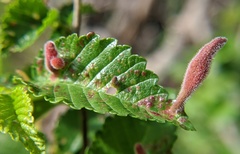 Rice Root AphidTetraneura akinire
 Manzanita Leafgall AphidTamalia coweni
 Giant Willow AphidTuberolachnus salignusDamages trees, gardens or crops
Sources
- Wikipedia: https://en.wikipedia.org/wiki/Aphis_nerii
Look it up elsewhere: GBIF · iNaturalist · BugGuide · ITIS · Wikipedia
Text written 2026-10-22 from the sources above and checked sentence by sentence against them. Data fetched 2026-10-22.