 Bug FAQ
Norton's Giant Ichneumonid Wasp
Megarhyssa nortoni · Order: Hymenoptera · Family: Ichneumonidae
Also called: Giant Sirex Parasitoid Wasp, Norton's Giant Ichneumon Wasp
Source: Wikipedia

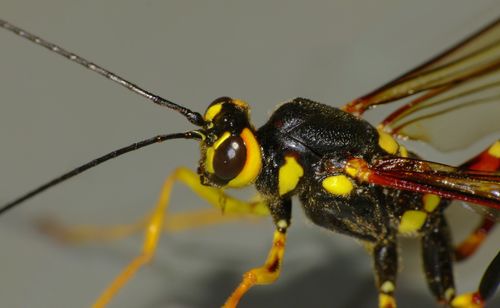
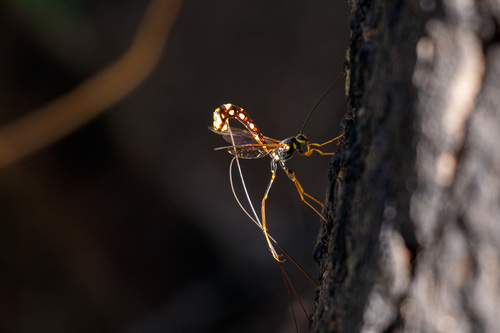
The female has a very long ovipositor, up to three inches long, which she uses to reach horntail larvae inside tree bark. Adults are black, reddish-brown and yellow with round yellow spots on the abdomen and mostly yellow legs.
Source: Wikipedia
How to recognize it
The wasp’s body is black, reddish-brown and yellow, and it has round yellow spots along the sides of the abdomen. Its legs are largely yellow.
Source: Wikipedia
Size
Females have an ovipositor that measures between two and three inches (51 to 76 mm).
Source: Wikipedia
What it eats
Adult wasps feed on nectar and water. The larvae are parasitoids that develop inside horntail wasp larvae in conifer trees.
Source: Wikipedia
Life cycle
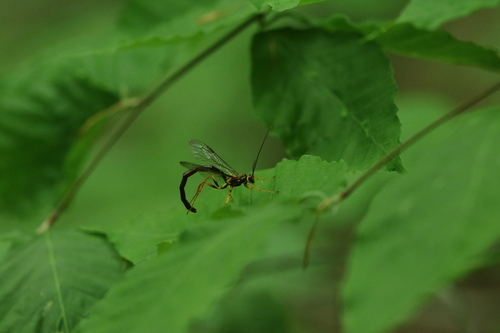
The larva pupates inside its horntail host and emerges the next summer as an adult. The female curls her ovipositor over her abdomen, inserts it at a right angle into bark, and drills down to the horntail tunnel.
Source: Wikipedia
Where it comes from
It is native to North America, occurring in parts of the United States and Canada.
Source: Wikipedia
Where it is found in the US
Recorded in 25 of 51 states and DC. Most records: California, Oregon, Washington, Utah, Alaska, Colorado, Montana, New Mexico.
Darker = more records. Counts are museum and citizen-science records, not population size.
Source: GBIF
Months it is reported in the US
Source: GBIF
More photos

Questions people ask
Where can I find this wasp?
It lives in conifer forests with horntail larvae and has been introduced to several countries for pest control.
Source: Wikipedia
Same family (Ichneumonidae)



Sources
- Wikipedia: https://en.wikipedia.org/wiki/Megarhyssa_nortoni
Look it up elsewhere: GBIF · iNaturalist · BugGuide · Wikipedia
Text written 2026-10-24 from the sources above and checked sentence by sentence against them. Data fetched 2026-10-24.