 Bug FAQ
Muscid fly
Graphomya maculata · Order: Diptera · Family: Muscidae

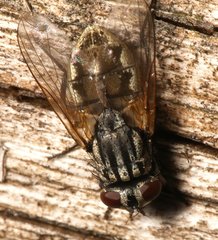
Both sexes have a black and white patterned thorax, while females have a black-white abdomen and males have orange on the abdomen. Adults feed on flower nectar in meadows, hedgerows and roadside vegetation; larvae are predatory in muddy pools and damp leaf litter.
Source: Wikipedia
How to recognize it
The thorax shows the same black and white pattern in males and females. Females have a black and white abdomen, while males have orange coloration on the abdomen.
Source: Wikipedia
Where it lives
Larvae are predatory and live in muddy pools and damp leaf litter.
Source: Wikipedia
What it eats
Adults feed on nectar from flowers. Larvae are predatory, feeding on other small organisms in muddy pools and leaf litter.
Source: Wikipedia
Where it is found in the US
Recorded in 4 of 51 states and DC. Most records: Alaska, Maryland, South Carolina, Virginia.
Darker = more records. Counts are museum and citizen-science records, not population size.
Source: GBIF
Months it is reported in the US
Source: GBIF
More photos


Questions people ask
What do the larvae of Graphomya maculata eat?
The larvae are predatory and feed on small organisms in muddy pools and damp leaf litter.
Source: Wikipedia
How can I recognize Graphomya maculata?
Both sexes have a black-white patterned thorax; females have a black-white abdomen while males have orange on the abdomen.
Source: Wikipedia
Same family (Muscidae)




Sources
- Wikipedia: https://en.wikipedia.org/wiki/Graphomya_maculata
Look it up elsewhere: GBIF · iNaturalist · BugGuide · Wikipedia
Text written 2026-10-23 from the sources above and checked sentence by sentence against them. Data fetched 2026-10-22.