 Bug FAQ
Noon Fly
Mesembrina meridiana · Order: Diptera · Family: Muscidae
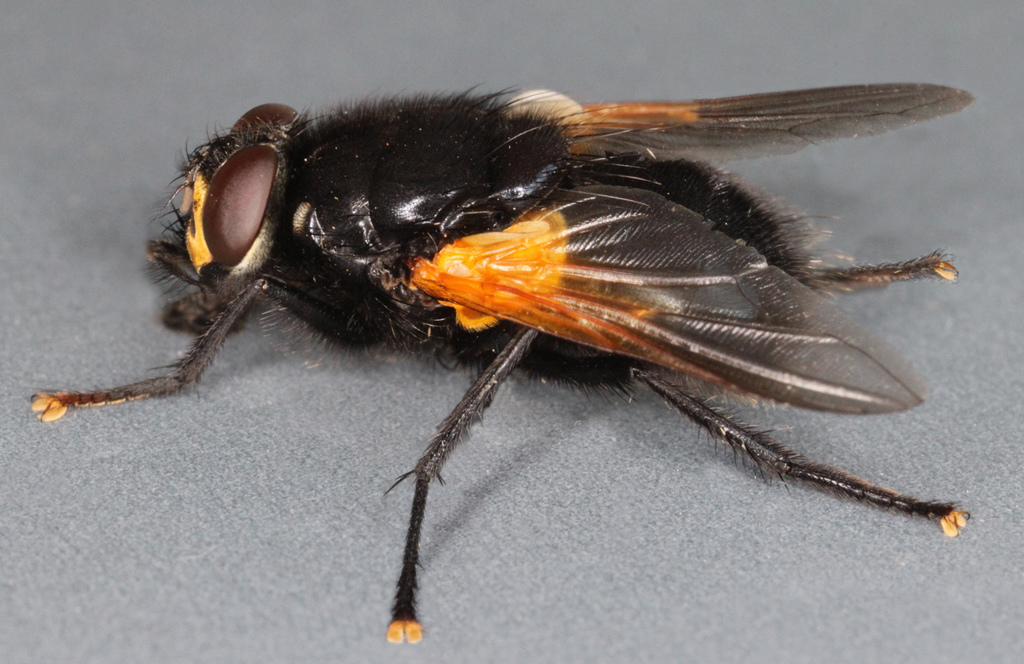
The noon fly is a medium-large fly about 9 to 13 mm long with a shiny black body and yellow-tinged hairs on the face and wings. Adults appear from late April to late October, especially around cattle, on cow dung or sunny ground. They feed on flower nectar and pollen, especially from Apiaceae, and the larvae eat other fly larvae in dung.
Source: Wikipedia
How to recognize it
They have a stout, shiny black body covered with uniform black hair; eyes are bare, cheeks have fine yellow hairs, and the arista is yellow with orange at the wing base, feet and face.
Source: Wikipedia
Size
They grow to a length of about 9 to 13 mm (0.35 to 0.51 in).
Source: Wikipedia
Where it lives
Mating takes place on cow or horse dung.
Source: Wikipedia
What it eats
Adults feed on nectar and pollen of flowers, especially Apiaceae such as Heracleum and Pastinaca, and on overripe berries. Larvae are carnivorous and eat other fly larvae inside dung.
Source: Wikipedia
Life cycle
The species is ovoviviparous; eggs hatch within an hour of being laid. A female lays up to five eggs in her lifetime, each in a different dung pat at two-day intervals.
Source: Wikipedia
When you see it
Adults are present from late April through late October.
Source: Wikipedia
Where it comes from
The species is common throughout most of Europe, the Near East, the eastern Palearctic (Russia, Mongolia, China) and North Africa.
Source: Wikipedia
Lookalikes
It can be confused with Mesembrina resplendens and Mesembrina intermedia.
Source: Wikipedia
Questions people ask
When can I see noon flies?
Adults are active from late April to late October, especially around cattle and on sunny ground.
Source: Wikipedia
What do adult noon flies eat?
They feed on nectar and pollen from flowers, especially Apiaceae, and also on overripe berries.
Source: Wikipedia
Where do noon flies live?
They are common in Europe, the Near East, eastern Palearctic regions and North Africa, often found on cow dung or open ground in cattle-rearing areas.
Source: Wikipedia
What do the larvae eat?
The larvae are carnivorous and consume other fly larvae within dung.
Source: Wikipedia
Same family (Muscidae)




Sources
- Wikipedia: https://en.wikipedia.org/wiki/Mesembrina_meridiana
Look it up elsewhere: GBIF · iNaturalist · BugGuide · Wikipedia
Text written 2026-10-22 from the sources above and checked sentence by sentence against them. Data fetched 2026-10-22.