 Bug FAQ
Stable Fly
Stomoxys calcitrans · Order: Diptera · Family: Muscidae
Source: journals.flvc.org, Wikipedia

Adult stable flies are 6 to 8 mm long, look like smaller houseflies but have a spotted abdomen and biting mouthparts. They breed in manure, rotting organic material and decaying vegetation near livestock, and the life cycle takes about two weeks in warm weather.
Source: Wikipedia
How to recognize it
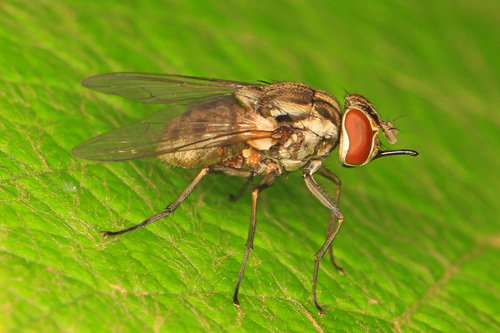
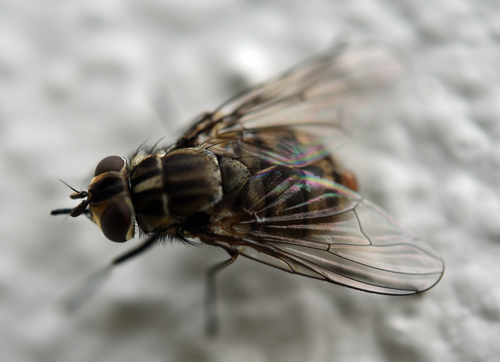
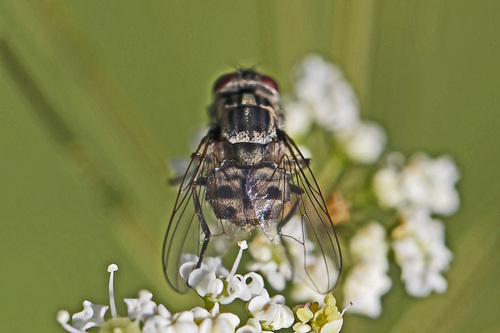
Stable flies look like smaller houseflies with a slightly wider, spotted abdomen. Unlike houseflies, their mouthparts are adapted for biting rather than sponging.
Source: Wikipedia
Size
Adults measure about 6 to 8 mm (¼ to 5⁄16 in) in length.
Source: Wikipedia
Is it a pest in the house?
Stable flies bite humans who are resting outdoors. They are a significant pest to people, pets, livestock, and tourism in places like Florida. Human activities such as farming create habitats and food sources that support stable flies.
Source: Wikipedia, journals.flvc.org
Does it bite or sting?
They bite humans when no animal hosts are available. In many regions they can carry trypanosome parasites that may be transmitted to hosts.
Source: Wikipedia, journals.flvc.org
How to get rid of it
Non-pesticide methods for controlling house and stable flies are described in USDA publications. University of Florida provides guidelines for stable fly (dog fly) control.
Source: journals.flvc.org
Where it lives
They are abundant around cattle and other livestock facilities. Larvae develop in rotting manure, hay, and other decaying organic material near animals. They can also be found in coastal areas where larvae live in decaying aquatic vegetation washed ashore.
Source: Wikipedia
Life cycle
At about 27 °C (81 °F), the complete life cycle lasts roughly two weeks. Larvae can survive more than 30 days in poorer nutritional conditions.
Source: Wikipedia
Where it comes from
The species originated in Eurasia or Africa and is now found worldwide.
Source: Wikipedia
Lookalikes
They resemble the common housefly but are smaller.
Source: Wikipedia
Where it is found in the US
Recorded in 49 of 51 states and DC. Most records: Texas, Michigan, California, Pennsylvania, New York, Illinois, Massachusetts, Virginia.
Darker = more records. Counts are museum and citizen-science records, not population size.
Source: GBIF
Status: introduced in North America; introduced in United States. Source: iNaturalist
Months it is reported in the US
Source: GBIF
More photos

Questions people ask
How can I control stable flies without chemicals?
The USDA and University of Florida offer non-pesticide strategies for managing stable flies.
Source: journals.flvc.org
Do stable flies bite people?
Yes, they bite humans, especially when resting outdoors and when animal hosts are scarce.
Source: Wikipedia, journals.flvc.org
Can stable flies spread disease?
In many parts of the world they carry trypanosome parasites.
Source: Wikipedia
Same family (Muscidae)



Sources
- journals.flvc.org: https://journals.flvc.org/edis/article/view/120135
- Wikipedia: https://en.wikipedia.org/wiki/Stable_fly
Look it up elsewhere: GBIF · iNaturalist · BugGuide · ITIS · Wikipedia
Text written 2026-10-23 from the sources above and checked sentence by sentence against them. Data fetched 2026-10-23.