 Bug FAQ
Common House Fly
Musca domestica · Order: Diptera · Family: Muscidae
Also called: House Fly

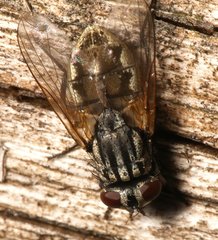
Adult house flies are about 6-7 mm long with a wingspan of 13-15 mm and are gray to black with four dark stripes on the thorax. They breed in decaying organic matter, lay batches of around 100 eggs, and the larvae (maggots) develop there before emerging as adults that live 2-4 weeks, often in summer. Because they carry pathogens on their bodies, mouthparts, vomit and feces, they can contaminate food and spread many illnesses.
How to recognize it
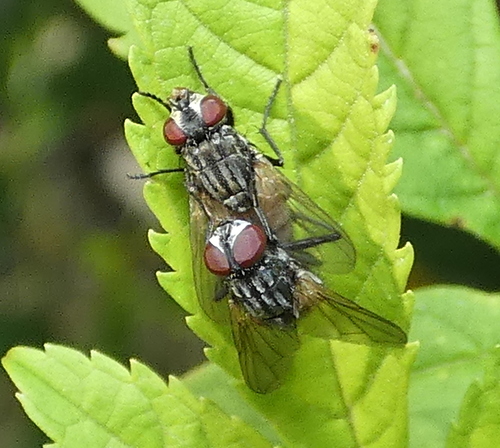
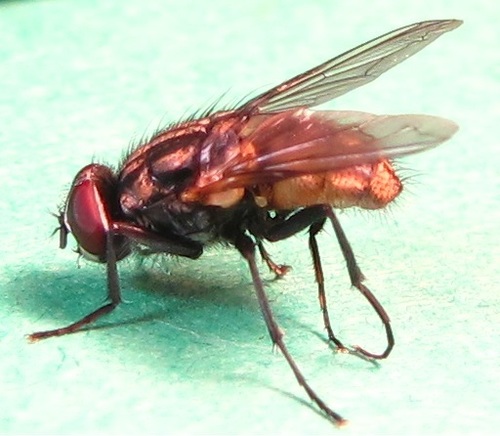
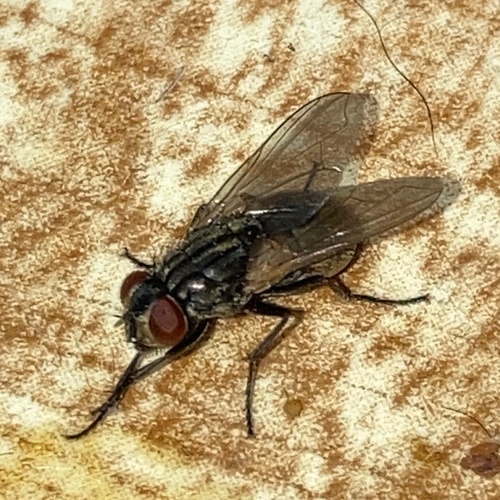
Their eyes are red and set farther apart in the slightly larger females.
Source: Wikipedia
Size
House flies measure about 6-7 mm in length with a wingspan of 13-15 mm. Females are generally larger and have broader wings, while males have relatively longer legs.
Source: Wikipedia
Is it a pest in the house?
They contaminate food and surfaces, leave dark spots on walls, and are a nuisance especially in large numbers. Because they spread over 100 pathogens, they are considered pests and can cause food-borne illnesses.
Does it bite or sting?
House flies cannot bite because they have sponging mouthparts, but they mechanically transmit many bacteria and viruses. They can spread diseases such as diarrhea, cholera, food poisoning, dysentery, and eye infections.
How to get rid of it
Removing breeding material is the best way to control house flies. Insecticides should be used only as a last resort for immediate adult control.
Source: UC IPM
Where it lives
Originating possibly in the Middle East, they now live worldwide wherever humans live.
Source: Wikipedia
What it eats
Adults feed on liquids, semi-liquids, and softened solids using their sponging mouthparts.
Source: Wikipedia
Life cycle
Females mate once, store sperm, and lay about 100 eggs on decaying matter; the eggs hatch into legless white maggots.
Source: Wikipedia
When you see it
Adults live 2-4 weeks but can hibernate in winter; they are most abundant in hot summer months. They can travel several kilometers from breeding sites, carrying microbes on their bodies and in their waste.
Where it comes from
Their original range is thought to be the Middle East, but they have spread globally as human commensals.
Source: Wikipedia
Lookalikes
Fannia flies rest with wings held flat over the back, unlike house flies that hold them in a V-shape. Fannia larvae are brown, flatter, and have many fleshy spines, unlike the white, round maggots of house flies.
Source: UC IPM
Where it is found in the US
Recorded in 51 of 51 states and DC. Most records: Texas, California, Florida, Arizona, Illinois, Tennessee, New York, Oregon.
Darker = more records. Counts are museum and citizen-science records, not population size.
Source: GBIF
Status: introduced in North America. Source: iNaturalist
Months it is reported in the US
Source: GBIF
More photos
Questions people ask
Can house flies spread disease?
Yes, they mechanically carry many pathogens and can cause food-borne illnesses.
How can I get rid of house flies?
Eliminate decaying organic material where they breed and use insecticides only if needed for adult flies.
Source: UC IPM
Same family (Muscidae)



Sources
- Wikipedia: https://en.wikipedia.org/wiki/Housefly
- UC IPM: https://ipm.ucanr.edu/PMG/PESTNOTES/pn7457.html
Look it up elsewhere: GBIF · iNaturalist · BugGuide · ITIS · Wikipedia
Text written 2026-10-22 from the sources above and checked sentence by sentence against them. Data fetched 2026-10-22.