 Bug FAQ
Mountain Mason Bee
Osmia inermis · Order: Hymenoptera · Family: Megachilidae
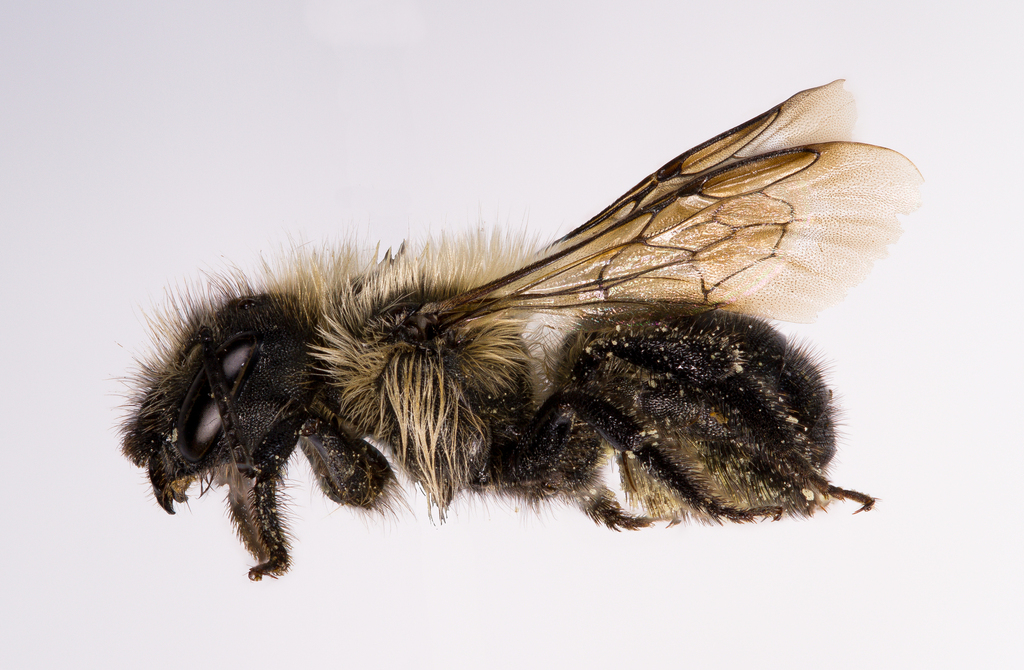
How to recognize it
Females are matte black about 10 mm long with some pale hairs; males are slightly smaller and have entirely black pubescence.
Source: Wikipedia
Size
Females reach about 10 mm in length, while males are a little shorter.
Source: Wikipedia
Where it lives
In Scotland it is found on exposed, base-rich uplands between 260 and 430 m above sea level. Elsewhere it occupies Arctic-alpine zones, low-altitude areas north of the Arctic Circle and montane sites further south.
Source: Wikipedia
What it eats
It collects pollen from a variety of plants, preferring Fabaceae and also using Vaccinium and Salix. In Scotland it feeds almost exclusively on Lotus corniculata.
Source: Wikipedia
Life cycle
Brood development inside nest cells takes at least two years and can extend to four years. In Scotland it produces one generation per year, with adults flying from late May to the end of July.
Source: Wikipedia
When you see it
Adults are on the wing from late May through the end of July.
Source: Wikipedia
Lookalikes
The chrysidid wasp Chrysura hirsuta is sometimes reared from the same nests and may be mistaken for this bee.
Source: Wikipedia
Where it is found in the US
Recorded in 17 of 51 states and DC. Most records: Alaska, California, Utah, Wyoming, Colorado, New Hampshire, Michigan, Washington.
Darker = more records. Counts are museum and citizen-science records, not population size.
Source: GBIF
Status: native in North America; native in United States; native in Canada. Source: iNaturalist
Months it is reported in the US
Source: GBIF
Questions people ask
What plants does the mountain mason bee visit?
It gathers pollen from many plants, especially legumes, Vaccinium and Salix, and in Scotland it relies almost entirely on Lotus corniculata.
Source: Wikipedia
When are mountain mason bees active?
Adults are on the wing from late May to the end of July.
Source: Wikipedia
Where can I find mountain mason bees?
They live in Arctic-alpine habitats across the Holarctic, including exposed uplands in Scotland and mountainous regions further south.
Source: Wikipedia
How can I tell a mountain mason bee from similar insects?
Females are matte black about 10 mm long with pale hairs, while males are slightly smaller and entirely black-pubescent; the chrysidid wasp Chrysura hirsuta may also appear in their nests.
Source: Wikipedia
Same family (Megachilidae)

Sources
- Wikipedia: https://en.wikipedia.org/wiki/Osmia_inermis
Look it up elsewhere: GBIF · iNaturalist · BugGuide · ITIS · Wikipedia
Text written 2026-10-27 from the sources above and checked sentence by sentence against them. Data fetched 2026-10-27.