 Bug FAQ
Lesser Brown Scorpion
Isometrus maculatus · Order: Scorpiones · Family: Buthidae
Also called: Spotted scorpion

The lesser brown scorpion grows to about 30 to 75 mm long. It belongs to the Buthidae family and is known as Isometrus maculatus. Its venom includes the toxins ImKTX58 and ImKTx88.
Source: Wikipedia
How to recognize it
Isometrus maculatus, called the lesser brown scorpion, is a Buthidae scorpion.
Source: Wikipedia
Size
Adults measure roughly 30 to 75 mm in total length.
Source: Wikipedia
Where it lives
It is found throughout tropical regions worldwide and has been introduced to Hawaii.
Source: Wikipedia
Where it comes from
Its distribution is pantropical, with an introduced population in Hawaii.
Source: Wikipedia
Where it is found in the US
Recorded in 1 of 51 states and DC. Most records: Hawaii.
Darker = more records. Counts are museum and citizen-science records, not population size.
Source: GBIF
Status: introduced in United States. Source: iNaturalist
Months it is reported in the US
Source: GBIF
More photos

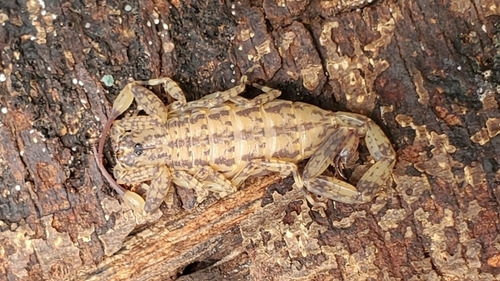
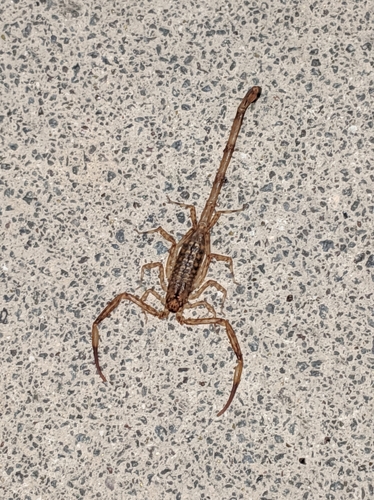
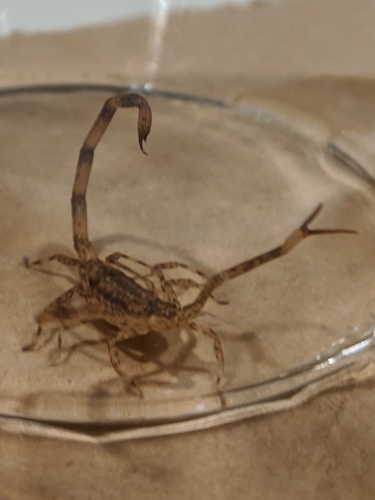
Questions people ask
What toxins are in the venom of the lesser brown scorpion?
Its venom includes the toxins ImKTX58 and ImKTx88.
Source: Wikipedia
Where is the lesser brown scorpion found?
It lives in pantropical areas and has been introduced to Hawaii.
Source: Wikipedia
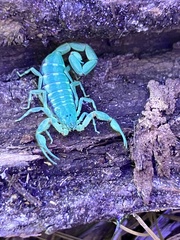
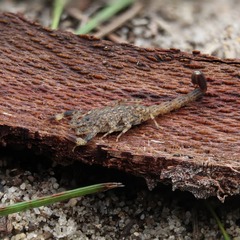
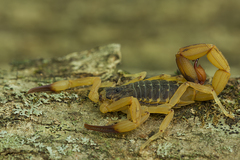
Same family (Buthidae)


Sources
- Wikipedia: https://en.wikipedia.org/wiki/Isometrus_maculatus
Look it up elsewhere: GBIF · iNaturalist · BugGuide · Wikipedia
Text written 2026-10-23 from the sources above and checked sentence by sentence against them. Data fetched 2026-10-23.