 Bug FAQ
Large fleabane daisy aphid
Uroleucon erigeronense · Order: Hemiptera · Family: Aphididae

It lives on many members of the aster family, moving from winter-time perennials to spring and summer annuals and herbs. In cooler areas it makes winged males and sexual females in the fall, while in warmer parts it can reproduce without a sexual cycle.
Source: Wikipedia
Where it lives
It occupies a wide range of aster family plants, shifting seasonally from overwintering perennials to blooming annuals and herbs.
Source: Wikipedia
What it eats
It also feeds on plants such as Eriophyllum.
Source: Wikipedia
Life cycle
In northern climates it produces winged males and sexual females in autumn. In southern United States it can reproduce without a sexual cycle.
Source: Wikipedia
Where it is found in the US
Recorded in 17 of 51 states and DC. Most records: California, Washington, Utah, Hawaii, Arizona, Idaho, Montana, Colorado.
Darker = more records. Counts are museum and citizen-science records, not population size.
Source: GBIF
Status: native in North America; native in Canada. Source: iNaturalist
Months it is reported in the US
Source: GBIF
More photos
Questions people ask
What plants does the large fleabane daisy aphid feed on?
It feeds on many aster family plants and also on Eriophyllum.
Source: Wikipedia
How does its reproduction differ between north and south?
In the north it makes winged males and sexual females in autumn, while in the south it can reproduce asexually.
Source: Wikipedia
Same family (Aphididae)
 Melon AphidAphis gossypiiDamages trees, gardens or crops
 Oleander AphidAphis neriiDamages trees, gardens or crops
 Witch-hazel Cone Gall AphidHormaphis hamamelidis
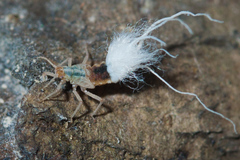 Beech Blight AphidGrylloprociphilus imbricatorDamages trees, gardens or crops
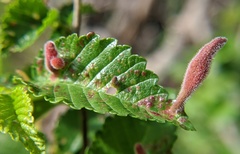 Rice Root AphidTetraneura nigriabdominalis
 Rose AphidMacrosiphum rosaeDamages trees, gardens or crops
Sources
- Wikipedia: https://en.wikipedia.org/wiki/Uroleucon_erigeronense
Look it up elsewhere: GBIF · iNaturalist · BugGuide · Wikipedia
Text written 2026-10-26 from the sources above and checked sentence by sentence against them. Data fetched 2026-10-26.