 Bug FAQ
Rose Aphid
Macrosiphum rosae · Order: Hemiptera · Family: Aphididae
Source: Wikipedia

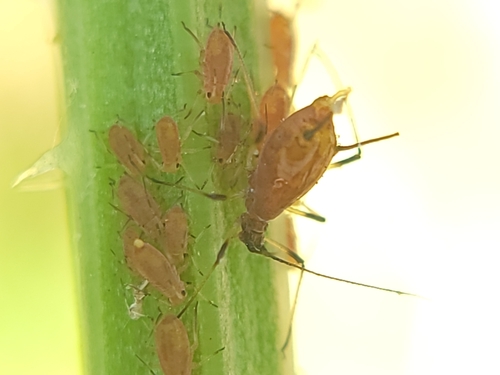
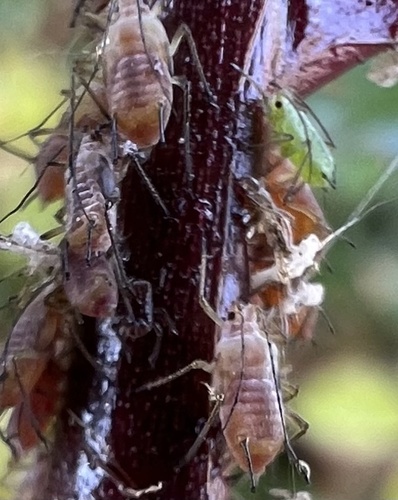
Wingless adults are spindle-shaped and 1.7 to 3.6 mm long, while winged forms are 2.2 to 3.4 mm; colour ranges from green to pink or reddish-brown, and the siphunculi are long, tapered and black. Large colonies deform flowers and foliage and excrete sticky honeydew, which promotes sooty mould on the plants.
Source: Wikipedia
How to recognize it
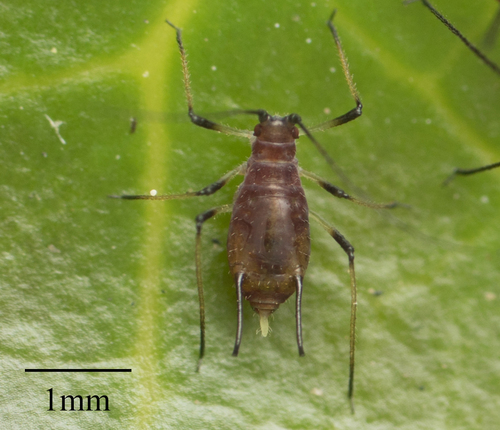
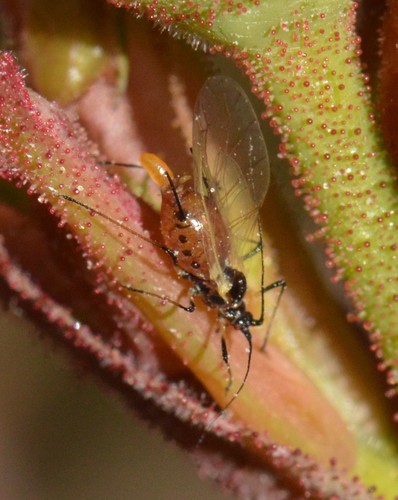
Colour varies from green to pink and reddish-brown. The pair of siphunculi are long, tapered and black, unlike the pale siphunculi of the rose-grain aphid.
Source: Wikipedia
Size
Wingless adults measure 1.7 to 3.6 mm in length. Winged individuals are 2.2 to 3.4 mm long.
Source: Wikipedia
Is it a pest in the house?
They damage the appearance of rosebushes by contorting flowers and foliage and by producing honeydew that supports sooty mould growth.
Source: Wikipedia
What it eats
Rose aphids feed by sucking sap from plants.
Source: Wikipedia
Life cycle
The species mainly overwinters as eggs on roses, though some adults may survive mild winters. Eggs hatch in spring into wingless females that reproduce parthenogenetically, allowing colonies to expand quickly.
Source: Wikipedia
Where it comes from
They have a worldwide distribution.
Source: Wikipedia
Lookalikes
They can be confused with Metopolophium dirhodum, but the latter has pale siphunculi while rose aphids have black siphunculi.
Source: Wikipedia
Where it is found in the US
Recorded in 26 of 51 states and DC. Most records: California, Pennsylvania, Oregon, Washington, New Mexico, Utah, New York, Idaho.
Darker = more records. Counts are museum and citizen-science records, not population size.
Source: GBIF
Status: introduced in North America; introduced in United States; introduced in Canada. Source: iNaturalist
Months it is reported in the US
Source: GBIF
More photos
Questions people ask
What do rose aphids look like?
They range in colour from green to pink or reddish-brown and have long, tapered black siphunculi on the abdomen.
Source: Wikipedia
How do rose aphids damage roses?
They deform flowers and foliage and excrete sticky honeydew that encourages the growth of sooty mould on the plants.
Source: Wikipedia
How can I tell rose aphids apart from rose-grain aphids?
Rose aphids have black, long, tapered siphunculi, whereas rose-grain aphids have pale siphunculi.
Source: Wikipedia
Same family (Aphididae)
 Melon AphidAphis gossypiiDamages trees, gardens or crops
 Oleander AphidAphis neriiDamages trees, gardens or crops
 Witch-hazel Cone Gall AphidHormaphis hamamelidis
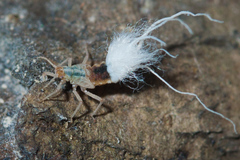 Beech Blight AphidGrylloprociphilus imbricatorDamages trees, gardens or crops
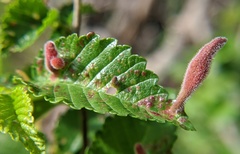 Rice Root AphidTetraneura nigriabdominalis
 Bean AphidAphis fabaeDamages trees, gardens or crops
Sources
- Wikipedia: https://en.wikipedia.org/wiki/Macrosiphum_rosae
Look it up elsewhere: GBIF · iNaturalist · BugGuide · Wikipedia
Text written 2026-10-25 from the sources above and checked sentence by sentence against them. Data fetched 2026-10-25.