 Bug FAQ
Ironweed Clearwing Moth
Carmenta bassiformis · Order: Lepidoptera · Family: Sesiidae
Also called: Eupatorium Borer Moth

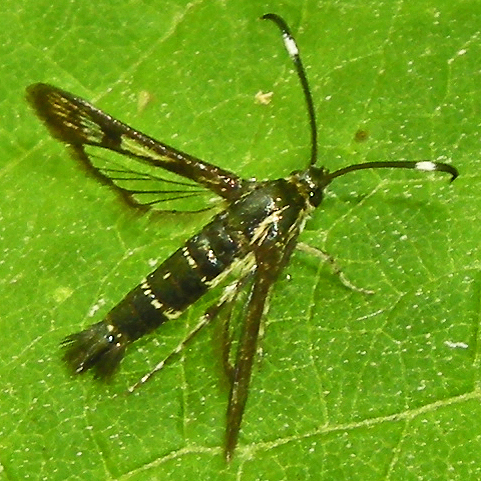
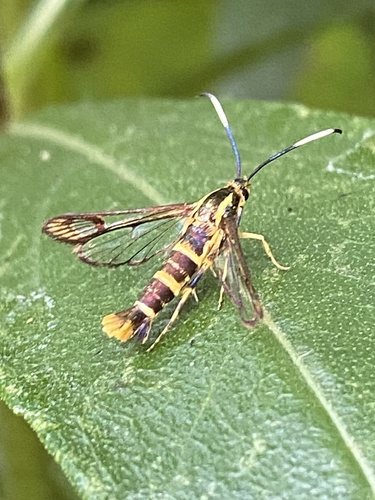
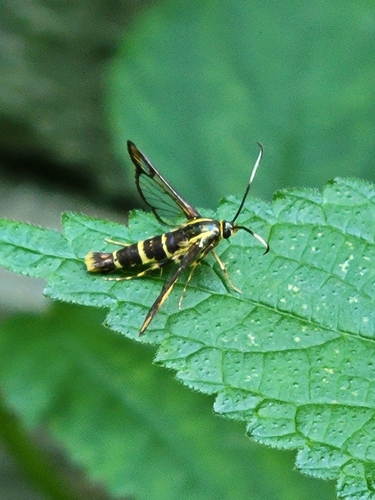
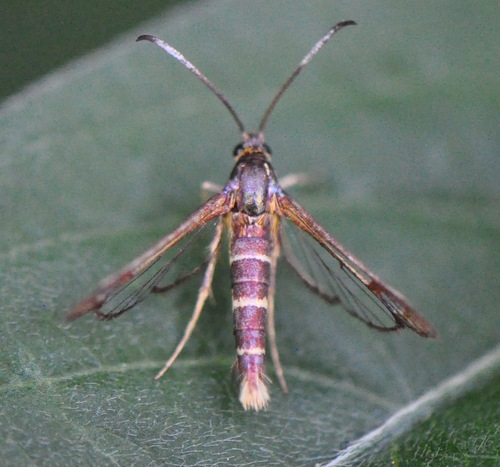
The ironweed clearwing moth has a wingspan of about 17-22 mm, with males a little smaller than females. Adults show clear or translucent wings edged with a dark border, a purplish-black thorax and abdomen marked with yellow stripes.
Source: Wikipedia
How to recognize it
The moth’s wings are clear or partly translucent with a dark border on the forewing, and both sexes have a purplish-black thorax and abdomen that bears yellow stripes.
Source: Wikipedia
Size
Males measure 17-20 mm across the wings, while females are slightly larger at 20-22 mm.
Source: Wikipedia
Life cycle
The species was first described by Francis Walker in 1856.
Source: Wikipedia
When you see it
Adult moths are active from late May through September.
Source: Wikipedia
Where it comes from
Its native range covers the eastern United States, extending from New York down to Florida and west to Wisconsin, Kansas and Texas.
Source: Wikipedia
Where it is found in the US
Recorded in 30 of 51 states and DC. Most records: Ohio, Pennsylvania, Virginia, North Carolina, Tennessee, Maryland, New York, Georgia.
Darker = more records. Counts are museum and citizen-science records, not population size.
Source: GBIF
Status: native in North America; native in Canada. Source: iNaturalist
Months it is reported in the US
Source: GBIF
More photos
Questions people ask
When can I expect to see adult ironweed clearwing moths?
Adults are on the wing from late May until September.
Source: Wikipedia
Same family (Sesiidae)
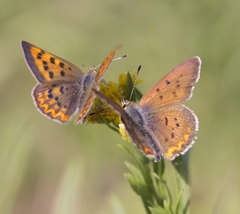 Purplish CopperLycaena helloides
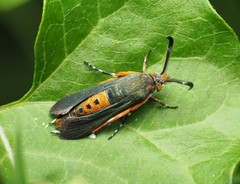 Squash Vine BorerEichlinia cucurbitaeDamages trees, gardens or crops
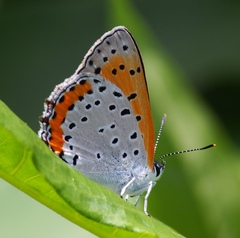 Bronze CopperLycaena hyllus
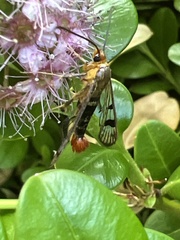 Maple Callus Borer MothSynanthedon acerniDamages trees, gardens or crops
 Southern Red RimBiblis hyperia
 Peachtree Borer MothSynanthedon exitiosaDamages trees, gardens or crops
Sources
- Wikipedia: https://en.wikipedia.org/wiki/Carmenta_bassiformis
Look it up elsewhere: GBIF · iNaturalist · BugGuide · Wikipedia
Text written 2026-10-24 from the sources above and checked sentence by sentence against them. Data fetched 2026-10-24.