 Bug FAQ
Southern Red Rim
Biblis hyperia · Order: Lepidoptera · Family: Sesiidae
Also called: Red Rim, Crimson-banded Black

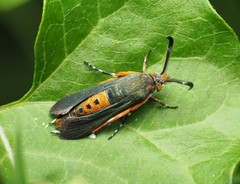
Adults have dark forewings and lighter hindwings with a pink-red band. They are seen flying from March through November in subtropical forests. Caterpillars feed on the plant Tragia volubilis.
Source: Wikipedia
How to recognize it
The forewing is velvety black while the hindwing is gray with a pinkish-red band.
Source: Wikipedia
Where it lives
They live in subtropical forest habitats.
Source: Wikipedia
What it eats
Larvae eat the plant Tragia volubilis.
Source: Wikipedia
Life cycle
Immature stages feed on Tragia volubilis.
Source: Wikipedia
When you see it
Adults are active from March to November.
Source: Wikipedia
Lookalikes
The genus Biblis has only this described species, though another undescribed one may exist.
Source: Wikipedia
Where it is found in the US
Recorded in 2 of 51 states and DC. Most records: Texas, Colorado.
Darker = more records. Counts are museum and citizen-science records, not population size.
Source: GBIF
Status: native in North America. Source: iNaturalist
Months it is reported in the US
Source: GBIF
Same family (Sesiidae)
Sources
- Wikipedia: https://en.wikipedia.org/wiki/Biblis_hyperia
Look it up elsewhere: GBIF · iNaturalist · BugGuide · ITIS · Wikipedia
Text written 2026-10-23 from the sources above and checked sentence by sentence against them. Data fetched 2026-10-22.