 Bug FAQ
Peachtree Borer Moth
Synanthedon exitiosa · Order: Lepidoptera · Family: Sesiidae
Also called: Peachtree Borer
Source: Wikipedia

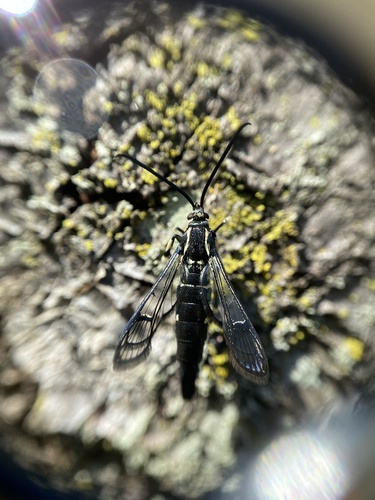
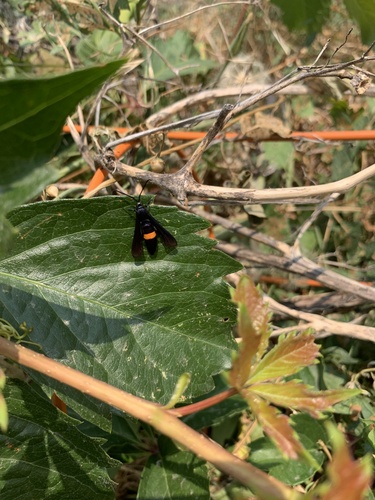
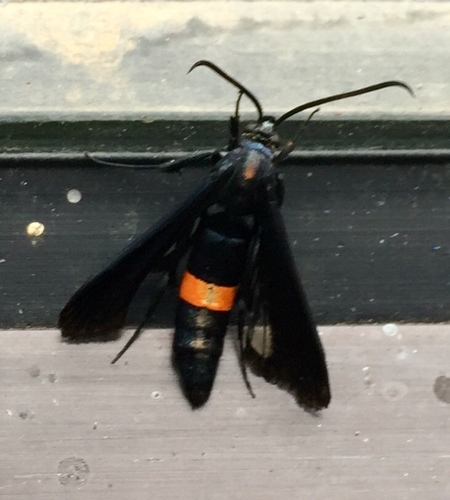
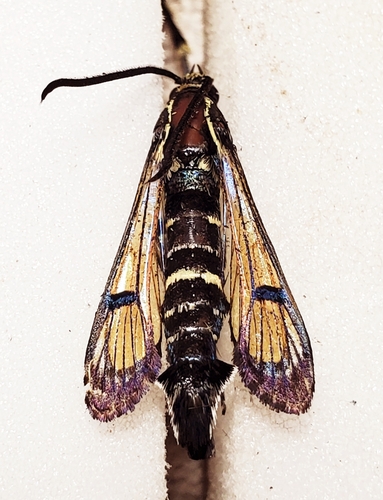
Adults are dark metallic blue with an orange band on the abdomen and have clear hindwings; males are smaller and more slender. Females lay eggs at the tree base and the larvae bore into the trunk, feeding on cambium and can kill the tree.
Source: Wikipedia
How to recognize it
The moth is dark metallic blue with an orange band around the abdomen. It has opaque forewings and clear hindwings; males are smaller and more slender.
Source: Wikipedia
Size
Adult females have a wingspan of about 3.5 cm. Larvae grow up to 3.5 cm long, are white with a brown head.
Source: Wikipedia
Is it a pest in the house?
It attacks peach, cherry and apricot trees, often killing them.
Source: Wikipedia
Where it lives
It lives on Prunus trees and shrubs such as peach, cherry and apricot. Females lay eggs around the trunk base and larvae bore into the wood.
Source: Wikipedia
What it eats
Larvae feed on the cambium of their host trees, causing severe damage.
Source: Wikipedia
Life cycle
Eggs are laid at the base of the trunk and hatch into larvae that bore into the tree. The feeding larvae can kill the tree by destroying the cambium.
Source: Wikipedia
Where it comes from
The peachtree borer is native to North America.
Source: Wikipedia
Where it is found in the US
Recorded in 48 of 51 states and DC. Most records: Michigan, Minnesota, Pennsylvania, New York, Ohio, North Carolina, Virginia, Maryland.
Darker = more records. Counts are museum and citizen-science records, not population size.
Source: GBIF
Status: native in North America; native in United States; native in Canada. Source: iNaturalist
Months it is reported in the US
Source: GBIF
More photos
Questions people ask
How does the peachtree borer damage trees?
The larvae bore into the trunk and feed on the cambium, which can kill the tree.
Source: Wikipedia
What trees are affected by the peachtree borer?
It attacks peach, cherry and apricot trees, which are all in the Prunus genus.
Source: Wikipedia
Same family (Sesiidae)

Sources
- Wikipedia: https://en.wikipedia.org/wiki/Synanthedon_exitiosa
Look it up elsewhere: GBIF · iNaturalist · BugGuide · Wikipedia
Text written 2026-10-23 from the sources above and checked sentence by sentence against them. Data fetched 2026-10-23.