 Bug FAQ
Florentine Woolcarder Bee
Anthidium florentinum · Order: Hymenoptera · Family: Megachilidae
Also called: Florentine Wool-carder Bee
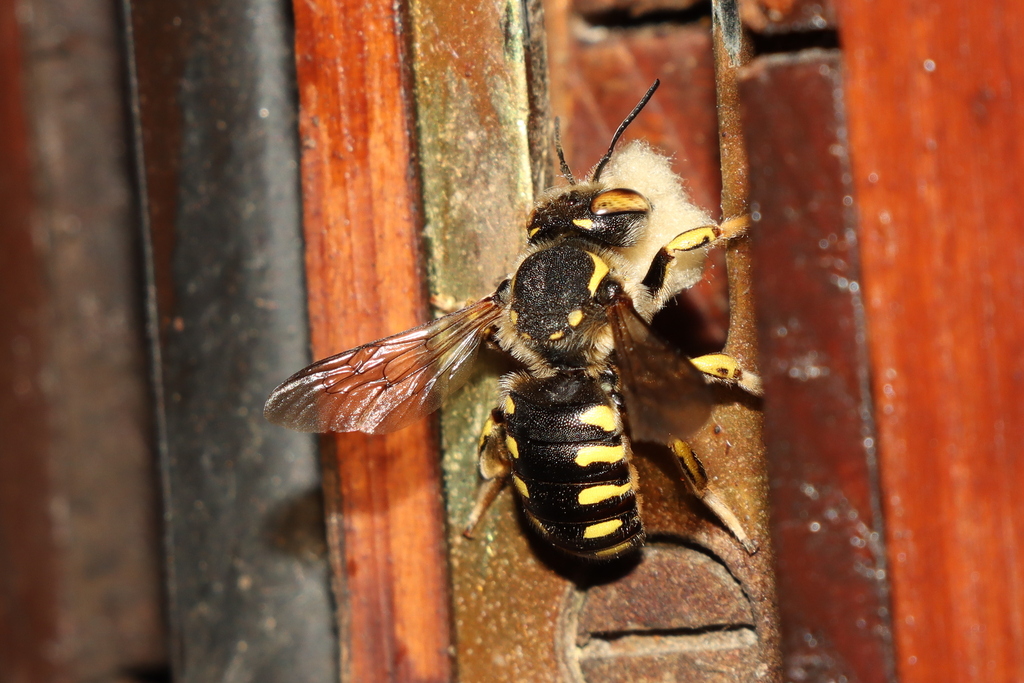
The Florentine woolcarder bee is a medium to large solitary bee with females smaller than males. Both sexes have a black abdomen with two yellow bands per segment, and males have grey-white hairs on the abdomen sides. It nests in crevices or abandoned nests of other insects, lining the nest with chewed plant fibers.
Source: Wikipedia
How to recognize it
Both sexes show a black abdomen marked with two yellow bands on each tergite. Males can be told apart by grey or whitish hairs along the sides of the abdomen.
Source: Wikipedia
Size
The species ranges from medium to large in size. Females are smaller than the males.
Source: Wikipedia
Where it lives
Nests are built in crevices or in abandoned nests of other insects.
Source: Wikipedia
What it eats
The nest is lined with chewed plant fibres.
Source: Wikipedia
Life cycle
In southern France, more females than males are produced, males are larger, and both sexes fly at the same time of year. This pattern may be due to prolonged female receptivity and males defending resources.
Source: Wikipedia
When you see it
Males and females are active during the same season.
Source: Wikipedia
Where it comes from
Anthidium florentinum is a European wool-carder bee. Specimens from Iran have been used in the United States as efficient alfalfa pollinators.
Source: Wikipedia
Lookalikes
It is one of several European wool-carder bee species. It occurs alongside Anthidium manicatum in parts of Europe.
Source: Wikipedia
Where it is found in the US
Recorded in 1 of 51 states and DC. Most records: New York.
Darker = more records. Counts are museum and citizen-science records, not population size.
Source: GBIF
Status: introduced in North America; introduced in Canada; introduced in United States. Source: iNaturalist
Same family (Megachilidae)

Sources
- Wikipedia: https://en.wikipedia.org/wiki/Anthidium_florentinum
Look it up elsewhere: GBIF · iNaturalist · BugGuide · ITIS · Wikipedia
Text written 2026-10-22 from the sources above and checked sentence by sentence against them. Data fetched 2026-10-22.