 Bug FAQ
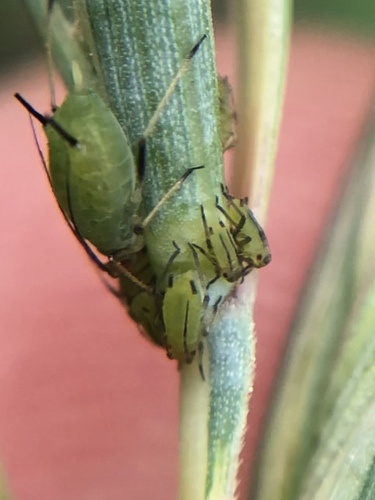
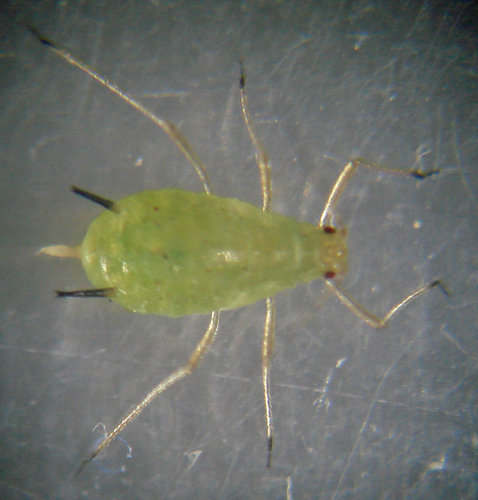
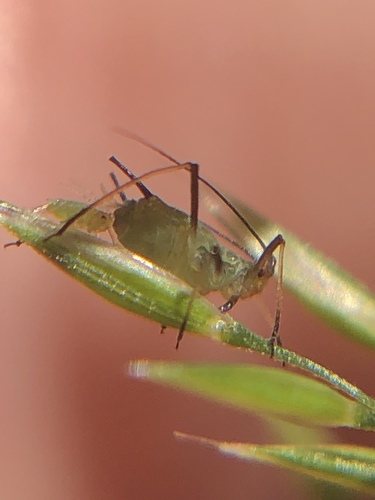
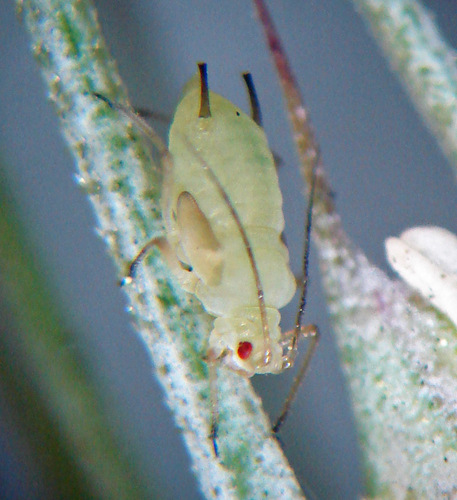
English Grain Aphid
Sitobion avenae · Order: Hemiptera · Family: Aphididae
Also called: Grain aphid
Source: Wikipedia

The English grain aphid lives on grasses, sedges and rushes and can become a serious pest of cereal crops. Some lines reproduce asexually in spring and summer, while shorter days and cooler temperatures in autumn trigger the production of sexual males and females that lay overwintering eggs.
Source: Wikipedia
Is it a pest in the house?
It can be a significant pest of cereal crops.
Source: Wikipedia
Where it lives
It is found on grasses, sedge and rushes.
Source: Wikipedia
What it eats
It feeds by sucking plant sap.
Source: Wikipedia
Life cycle
Some genotypes reproduce only by parthenogenesis, while others can switch to sexual reproduction. In spring and summer it reproduces asexually; decreasing daylight and temperature in autumn cause it to produce sexual males and females, which mate and lay eggs that overwinter and hatch after a cold period.
Source: Wikipedia
Where it is found in the US
Recorded in 28 of 51 states and DC. Most records: California, Illinois, North Carolina, Tennessee, Minnesota, Washington, Wisconsin, New York.
Darker = more records. Counts are museum and citizen-science records, not population size.
Source: GBIF
Status: introduced in Canada; native in Canada. Source: iNaturalist
Months it is reported in the US
Source: GBIF
More photos
Questions people ask
How does the English grain aphid reproduce?
It can reproduce asexually in warm months and switches to sexual reproduction in autumn when days shorten and temperatures drop.
Source: Wikipedia
What plants does it damage?
It damages cereals such as wheat and barley by feeding on their sap.
Source: Wikipedia
Same family (Aphididae)
 Melon AphidAphis gossypiiDamages trees, gardens or crops
 Oleander AphidAphis neriiDamages trees, gardens or crops
 Witch-hazel Cone Gall AphidHormaphis hamamelidis
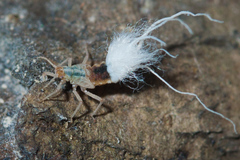 Beech Blight AphidGrylloprociphilus imbricatorDamages trees, gardens or crops
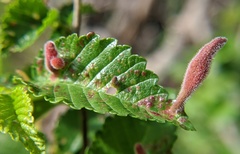 Rice Root AphidTetraneura nigriabdominalis
 Rose AphidMacrosiphum rosaeDamages trees, gardens or crops
Sources
- Wikipedia: https://en.wikipedia.org/wiki/Sitobion_avenae
Look it up elsewhere: GBIF · iNaturalist · BugGuide · ITIS · Wikipedia
Text written 2026-10-25 from the sources above and checked sentence by sentence against them. Data fetched 2026-10-25.