 Bug FAQ
Dusky Clearwing Moth
Paranthrene tabaniformis · Order: Lepidoptera · Family: Sesiidae
Also called: European Poplar Clearwing Moth, Dusky Clearwing
Source: Wikipedia
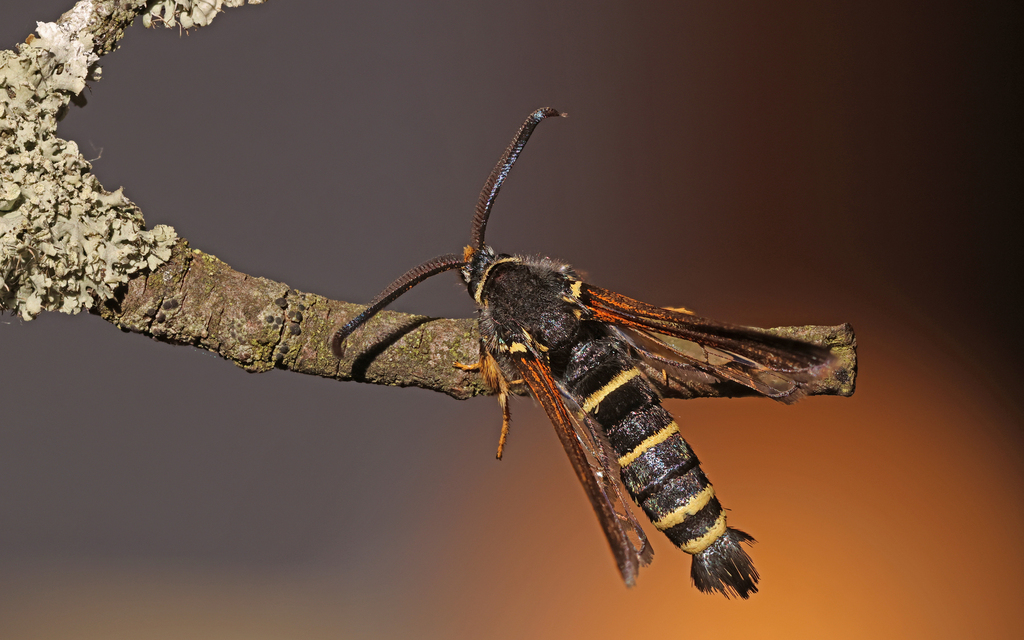
Adults have a wingspan of about 30 mm and forewings about 14 mm long. It mimics wasps in appearance, likely as Batesian mimicry.
Source: Wikipedia
How to recognize it
The head shows a white vertical bar before each eye and a yellow ring behind the eyes. The abdomen has yellow rings on segments 2, 4, 6 and sometimes 7, and the middle and rear tibiae are orange with black bands.
Source: Wikipedia
Size
Wingspan is roughly 30 mm. Forewing length is about 14 mm.
Source: Wikipedia
Is it a pest in the house?
The moth resembles a wasp, likely as a defensive mimicry.
Source: Wikipedia
Where it lives
Pupae are found inside one-year poplar seedlings or under bark of older trees.
Source: Wikipedia
What it eats
Larvae feed on poplar, willow and sea-buckthorn.
Source: Wikipedia
Life cycle
Larvae pass through six to seven growth stages. Mature larvae pupate in chambers they build within their galleries.
Source: Wikipedia
When you see it
Adults are on the wing from May through August, varying by location.
Source: Wikipedia
Where it comes from
It occurs in the Palearctic region and also in North America.
Source: Wikipedia
Lookalikes
It can be mistaken for a wasp because of its similar coloration and shape.
Source: Wikipedia
Where it is found in the US
Recorded in 17 of 51 states and DC. Most records: Michigan, Minnesota, Montana, Wisconsin, Texas, Colorado, Connecticut, Ohio.
Darker = more records. Counts are museum and citizen-science records, not population size.
Source: GBIF
Status: native in North America; native in Canada; native in United States. Source: iNaturalist
Months it is reported in the US
Source: GBIF
More photos
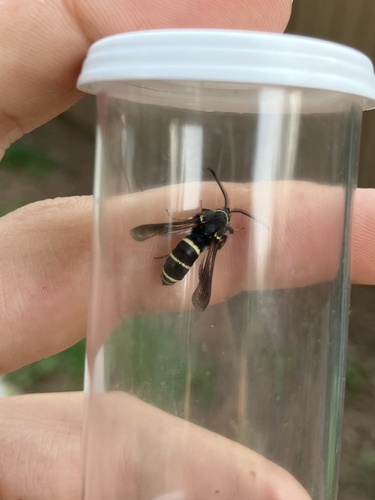
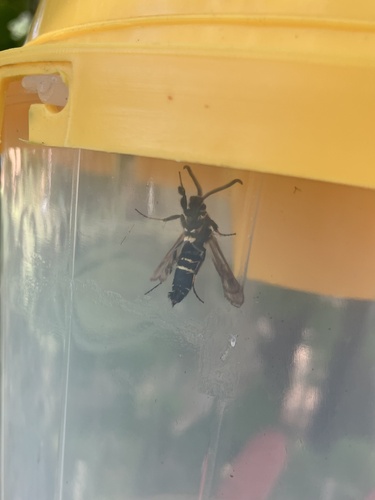
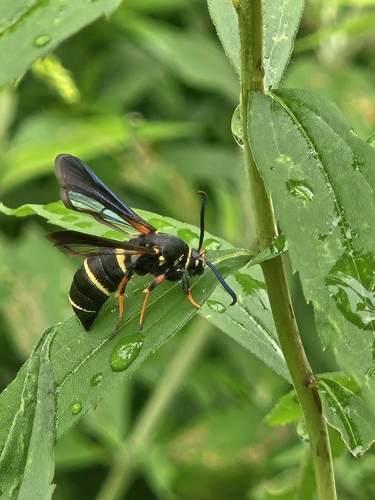
Questions people ask
What trees do the larvae feed on?
The caterpillars eat poplar, willow and sea-buckthorn.
Source: Wikipedia
When can I see adult Dusky Clearwing Moths?
Adults fly from May to August, depending on where you are.
Source: Wikipedia
How can I tell this moth apart from a wasp?
Look for the white vertical bars on the head and the yellow rings on the abdomen, which wasps lack.
Source: Wikipedia
Same family (Sesiidae)
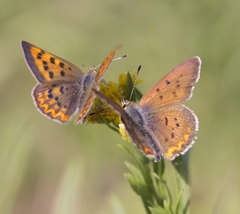 Purplish CopperLycaena helloides
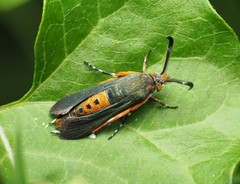 Squash Vine BorerEichlinia cucurbitaeDamages trees, gardens or crops
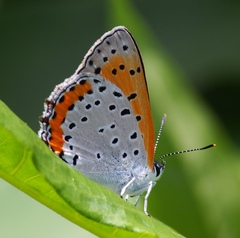 Bronze CopperLycaena hyllus
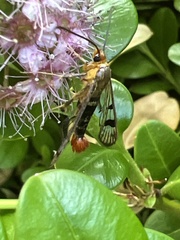 Maple Callus Borer MothSynanthedon acerniDamages trees, gardens or crops
 Southern Red RimBiblis hyperia
 Peachtree Borer MothSynanthedon exitiosaDamages trees, gardens or crops
Sources
- Wikipedia: https://en.wikipedia.org/wiki/Paranthrene_tabaniformis
Look it up elsewhere: GBIF · iNaturalist · BugGuide · Wikipedia
Text written 2026-10-27 from the sources above and checked sentence by sentence against them. Data fetched 2026-10-27.