 Bug FAQ
Common Wheat-louse
Schizaphis graminum · Order: Hemiptera · Family: Aphididae
Also called: Spring green aphid
Source: Wikipedia
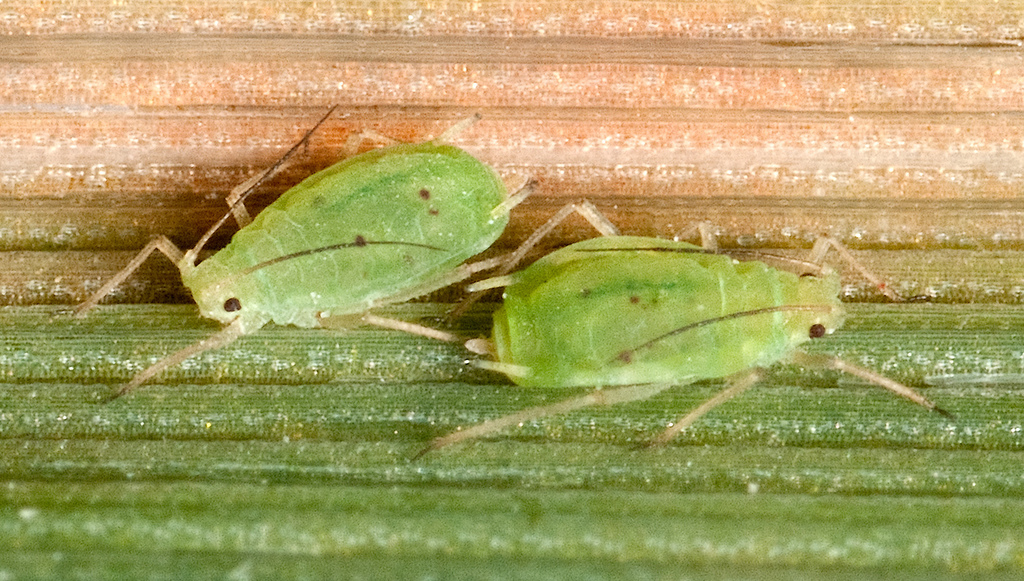
Adult greenbugs are tiny, about 1.3 to 2.1 mm long, with straw-colored heads and thoraxes, a mid-green abdomen marked by a dark dorsal stripe, dark antennae and pale cornicles tipped dark. Females reproduce without mating, producing up to five nymphs a day; the insects pass through three instars and complete a generation in 7 to 9 days at 16 to 27 °C. They feed by sucking sap from grasses and can reduce the size and yield of susceptible small-grain crops, and they also attack pearl millet in Pakistan.
Source: Wikipedia
Size
Adults measure between 1.3 and 2.1 mm in length.
Source: Wikipedia
What it eats
When on grasses they feed by sucking plant sap.
Source: Wikipedia
Life cycle
In warm or moderate climates females reproduce asexually, producing up to five nymphs per day. There are three nymphal instars and a full generation takes about 7 to 9 days at temperatures of 16 to 27 °C.
Source: Wikipedia
When you see it
Early in the season adults are wingless, but crowding induces winged forms that disperse to nearby plants.
Source: Wikipedia
Where it comes from
Its original distribution is the Palaearctic region.
Source: Wikipedia
Where it is found in the US
Recorded in 14 of 51 states and DC. Most records: Illinois, California, Tennessee, North Carolina, New Mexico, Idaho, Texas, Iowa.
Darker = more records. Counts are museum and citizen-science records, not population size.
Source: GBIF
Status: native in Canada. Source: iNaturalist
Months it is reported in the US
Source: GBIF
Questions people ask
What do they look like?
They have straw-colored heads and thoraxes, a mid-green abdomen with a dark stripe, dark antennae, and pale cornicles with dark tips.
Source: Wikipedia
What crops can they damage?
They can lower the size and yield of small-grain crops and are also a pest of pearl millet.
Source: Wikipedia
How do they reproduce?
Females reproduce asexually, giving birth to up to five nymphs each day.
Source: Wikipedia
Same family (Aphididae)
 Melon AphidAphis gossypiiDamages trees, gardens or crops
 Oleander AphidAphis neriiDamages trees, gardens or crops
 Witch-hazel Cone Gall AphidHormaphis hamamelidis
 Beech Blight AphidGrylloprociphilus imbricatorDamages trees, gardens or crops
 Rice Root AphidTetraneura nigriabdominalis
 Rose AphidMacrosiphum rosaeDamages trees, gardens or crops
Sources
- Wikipedia: https://en.wikipedia.org/wiki/Schizaphis_graminum
Look it up elsewhere: GBIF · iNaturalist · BugGuide · Wikipedia
Text written 2026-10-29 from the sources above and checked sentence by sentence against them. Data fetched 2026-10-29.