 Bug FAQ
Coenosia attenuata
Coenosia attenuata · Order: Diptera · Family: Muscidae
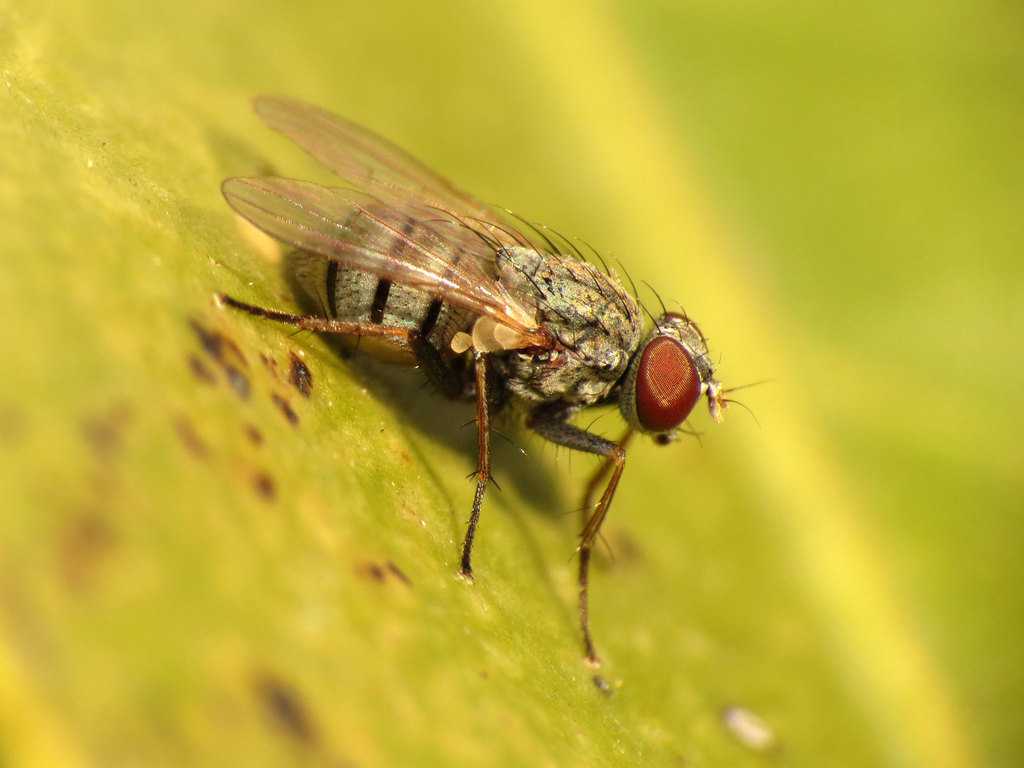
Males have yellow antennae and legs, while females show brownish heads, black antennae and femora, and distinct black bands on the abdomen. They are generalist predators that catch small insects in mid-air, including fungus gnats and various greenhouse pests.
Source: Wikipedia
How to recognize it
Males have yellow antennae and legs; females have brownish frons, a golden ocellar triangle, black antennae and femora, and black abdominal bands.
Source: Wikipedia
Size
Adults measure between 2.5 and 4 mm in length.
Source: Wikipedia
Where it lives
The species has been recorded throughout North and South America.
Source: Wikipedia
What it eats
Coenosia attenuata is an effective generalist predator of small insects like whiteflies, thrips, psyllids and various flies. It captures prey in mid-air using its front legs.
Source: Wikipedia
Where it comes from
It is native to southern Europe, occurring in countries such as Spain, France, Italy, Germany and Greece.
Source: Wikipedia
Where it is found in the US
Recorded in 3 of 51 states and DC. Most records: California, Arizona, Georgia.
Darker = more records. Counts are museum and citizen-science records, not population size.
Source: GBIF
Status: introduced in Canada; introduced in United States. Source: iNaturalist
Months it is reported in the US
Source: GBIF
Questions people ask
What do Coenosia attenuata flies eat?
They prey on small insects like whiteflies, thrips, psyllids, fungus gnats and other tiny flies, catching them in mid-air with their front legs.
Source: Wikipedia
Where can I find Coenosia attenuata?
They have been found throughout North and South America and are native to southern Europe.
Source: Wikipedia
How can I tell male and female Coenosia attenuata apart?
Males have yellow antennae and legs, while females have brownish heads, black antennae and femora, and distinct black bands on the abdomen.
Source: Wikipedia
Same family (Muscidae)




Sources
- Wikipedia: https://en.wikipedia.org/wiki/Coenosia_attenuata
Look it up elsewhere: GBIF · iNaturalist · BugGuide · Wikipedia
Text written 2026-10-26 from the sources above and checked sentence by sentence against them. Data fetched 2026-10-26.