 Bug FAQ
Blue Ant
Diamma bicolor · Order: Hymenoptera · Family: Crabronidae
Also called: Typical Weevil Wasps and Allies
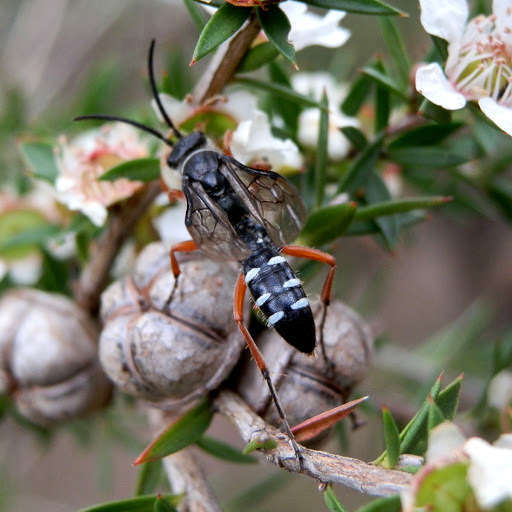
Blue ants are actually large solitary wasps with a metallic blue-green body and red legs. Females are wingless and up to 25 mm long, while males are smaller, about 15 mm, and have wings. They nest on the ground in south-east Australia and hunt mole crickets, paralyzing them with venom to lay an egg on the prey.
Source: Wikipedia
How to recognize it
They have a shiny blue-green body and red legs.
Source: Wikipedia
Size
Females can reach about 25 mm (1 in) and lack wings. Males are smaller, around 15 mm (5⁄8 in), and are winged.
Source: Wikipedia
Where it lives
They build nests on the ground. They are not aggressive unless provoked.
Source: Wikipedia
What it eats
Adults feed on nectar and pollinate native flowers such as Lomatia silaifolia. Females sting mole crickets, paralyze them with venom, and lay an egg on the immobilised prey.
Source: Wikipedia
Life cycle
Unlike other thynnid wasps, they exclusively hunt mole crickets for their larvae. The cricket is paralyzed by the female’s venom before an egg is deposited on it.
Source: Wikipedia
Lookalikes
Despite the name, they are not ants but large solitary parasitic wasps.
Source: Wikipedia
Where it is found in the US
Recorded in 50 of 51 states and DC. Most records: Florida, Texas, Arizona, Illinois, California, Ohio, Pennsylvania, New Mexico.
Darker = more records. Counts are museum and citizen-science records, not population size.
Source: GBIF
Months it is reported in the US
Source: GBIF
Questions people ask
Are blue ants actually ants?
No, they are a species of large solitary parasitic wasp.
Source: Wikipedia
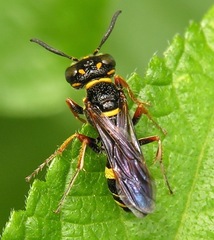
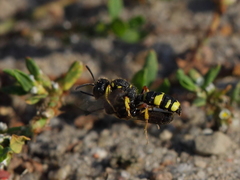
Same family (Crabronidae)

Sources
- Wikipedia: https://en.wikipedia.org/wiki/Blue_ant
Look it up elsewhere: GBIF · iNaturalist · BugGuide · Wikipedia
Text written 2026-10-23 from the sources above and checked sentence by sentence against them. Data fetched 2026-10-22.