 Bug FAQ
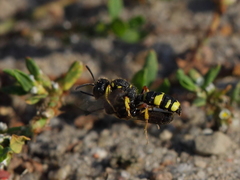
Black Cockroach-hunter Wasp
Tachysphex nigerrimus · Order: Hymenoptera · Family: Crabronidae

The black cockroach-hunter wasp (Tachysphex nigerrimus) is found only in New Zealand. Females hunt native cockroaches, sting them to paralyse, and bring three prey items back to provision each larva.
Source: Wikipedia
How to recognize it
The same common name is also used for other New Zealand hunting wasps such as Pison spinolae and Priocnemis monachus.
Source: Wikipedia
Where it lives
It builds small, simple burrows in sand, silty riverbanks above flood level, and can even burrow into rock.
Source: Wikipedia
What it eats
Female wasps hunt native cockroaches such as Celatoblatta or Parellipsidion, sting them to paralyse, and transport them to their burrow. Each larva is typically supplied with three cockroaches as food.
Source: Wikipedia
Life cycle
The curved white eggs are about 3.5 mm long and 0.7 mm wide, laid on the cockroach and cemented to it; the hatching larva eats the still-alive host.
Source: Wikipedia
Where it comes from
The species is endemic to New Zealand.
Source: Wikipedia
Questions people ask
What does the black cockroach-hunter wasp eat?
Females hunt native cockroaches, sting them to paralyse, and bring three of them back to feed each larva.
Source: Wikipedia
Where does this wasp live?
It is endemic to New Zealand and makes small burrows in sand, silty riverbanks above flood level, or even in rock.
Source: Wikipedia
How does the wasp reproduce?
The female lays curved white eggs on a paralyzed cockroach; the larva hatches and eats the still-alive host.
Source: Wikipedia
Are there other insects called black cockroach-hunter?
Yes, the same common name is also used for other New Zealand hunting wasps such as Pison spinolae and Priocnemis monachus.
Source: Wikipedia
Same family (Crabronidae)

Sources
- Wikipedia: https://en.wikipedia.org/wiki/Tachysphex_nigerrimus
Look it up elsewhere: GBIF · iNaturalist · BugGuide · ITIS · Wikipedia
Text written 2026-10-23 from the sources above and checked sentence by sentence against them. Data fetched 2026-10-23.