 Bug FAQ
Black-and-gray Leafcutter Bee
Megachile melanophaea · Order: Hymenoptera · Family: Megachilidae
Also called: Black-and-gray Leaf-cutter Bee, Black-and-gray Leafcutter

Females are about 12 to 14 mm long and males 9 to 12 mm. They nest in ground holes or other small cavities and are common across North America.
Source: Wikipedia
How to recognize it
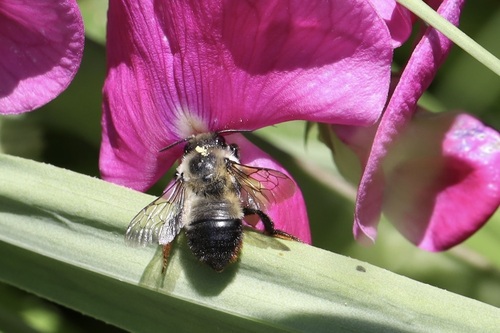
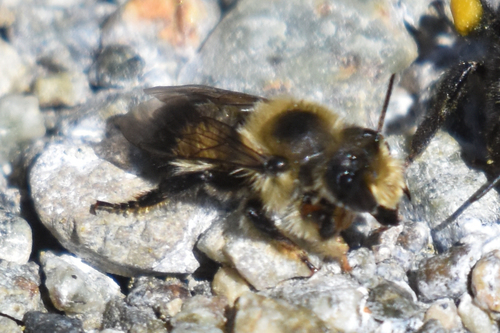
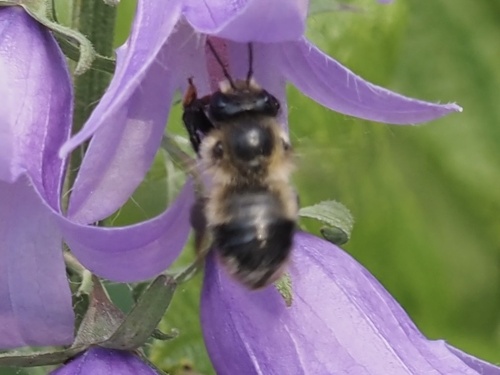
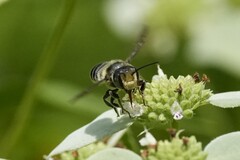
The head is black with brownish-black hairs, except for yellowish-white hairs on the lower face and antenna bases. The thorax is densely covered in hairs that are yellowish-white on top and sides, and brownish-black underneath and on the legs.
Source: Wikipedia
Size
Females measure 12 to 14 mm; males are slightly smaller at 9 to 12 mm.
Source: Wikipedia
Where it lives
They commonly nest in holes in the ground or other small cavities.
Source: Wikipedia
What it eats
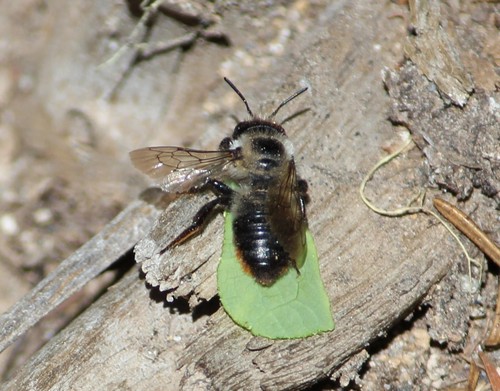
Adults visit flowers to collect nectar and pollen. Each brood cell is lined with cut leaf pieces and stocked with nectar and pollen for the larva.
Source: Wikipedia
Life cycle
One egg is laid in each leaf-lined cell.
Source: Wikipedia
Where it comes from
They are native to North America. Their distribution runs from Nova Scotia west to British Columbia and up to Alaska.
Source: Wikipedia
Where it is found in the US
Recorded in 30 of 51 states and DC. Most records: Utah, Colorado, California, Wyoming, Washington, Michigan, Maine, Arizona.
Darker = more records. Counts are museum and citizen-science records, not population size.
Source: GBIF
Status: native in North America; native in Canada; native in United States. Source: iNaturalist
Months it is reported in the US
Source: GBIF
More photos
Questions people ask
What size are Black-and-gray Leafcutter Bees?
Females are about 12 to 14 mm long and males 9 to 12 mm.
Source: Wikipedia
What do they eat?
Adults feed on nectar and pollen from flowers, and they provision their brood cells with the same foods.
Source: Wikipedia
Same family (Megachilidae)

Sources
- Wikipedia: https://en.wikipedia.org/wiki/Megachile_melanophaea
Look it up elsewhere: GBIF · iNaturalist · BugGuide · ITIS · Wikipedia
Text written 2026-10-23 from the sources above and checked sentence by sentence against them. Data fetched 2026-10-23.