 Bug FAQ
Bent-shielded Besieger Wasp
Gnamptopelta obsidianator · Order: Hymenoptera · Family: Ichneumonidae
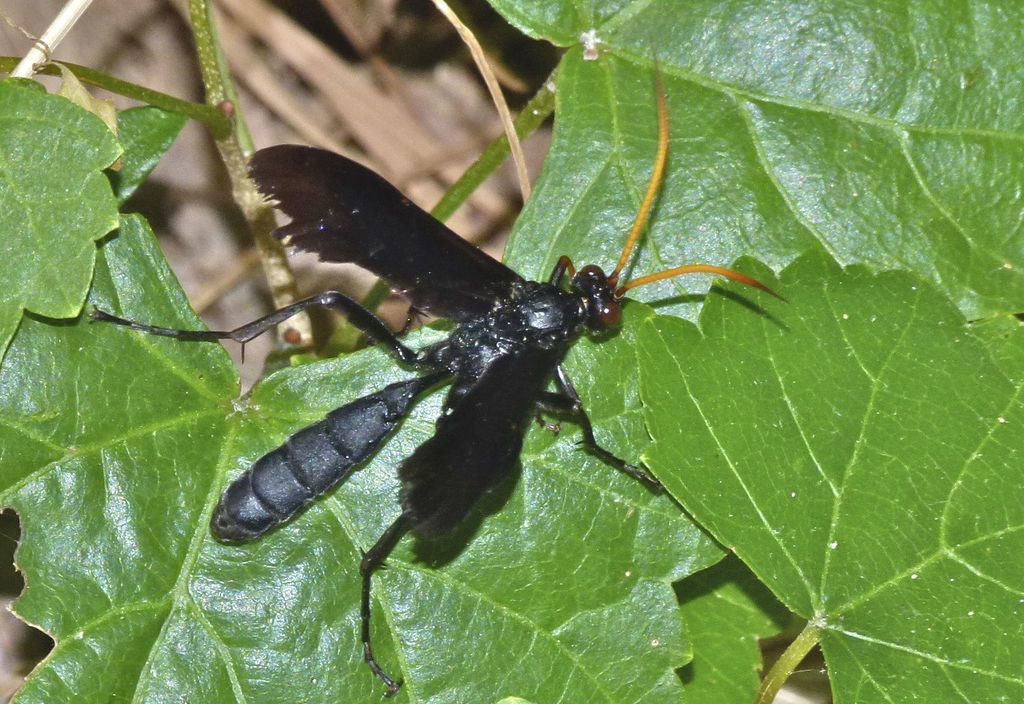
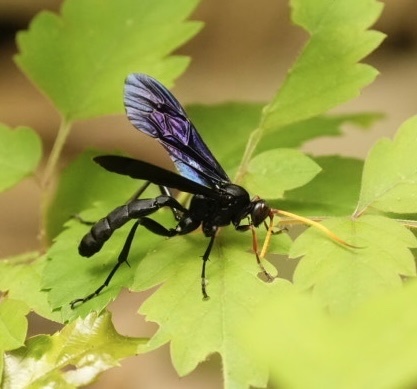
The bent-shielded besieger wasp is a large, almost entirely black wasp about 20 to 23 mm long, with orange-yellow antennae and yellowish-brown tibiae and tarsi. Females lay eggs inside late-instar caterpillars that feed on wild grape vines, and the adults are seen flying in spring from March to May.
Source: Wikipedia
How to recognize it
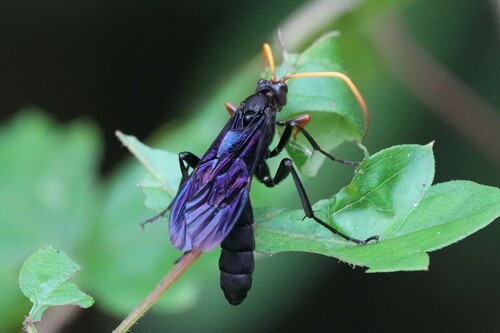
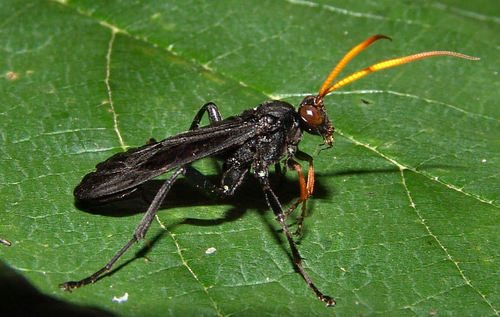
The body is nearly all black, including the wings, while the fore and mid leg tibiae and tarsi are yellowish-brown. Antennae are orange-yellow, sometimes with blackish tips.
Source: Wikipedia
Size
Adults measure between 20 and 23 mm in length. The clypeus has a concave shape that separates this species from related genera.
Source: Wikipedia
Where it lives
It occurs across eastern North America from Quebec down to Florida and west to Manitoba and New Mexico.
Source: Wikipedia
What it eats
Females parasitize caterpillars of Macroglossinae that feed on the wild grape Vitis aestivalis.
Source: Wikipedia
Life cycle
Adults are active in spring, typically from March through May. Eggs are deposited inside third- to fifth-instar caterpillars.
Source: Wikipedia
When you see it
The flight period for adults spans March to May.
Source: Wikipedia
Where it comes from
Its range includes eastern Canada and the eastern United States.
Source: Wikipedia
Lookalikes
It resembles Conocalma brullei but lacks the raised petiole structure and has a differently shaped clypeus.
Source: Wikipedia
Where it is found in the US
Recorded in 36 of 51 states and DC. Most records: Texas, New York, Illinois, Florida, Virginia, Louisiana, Massachusetts, Maryland.
Darker = more records. Counts are museum and citizen-science records, not population size.
Source: GBIF
Months it is reported in the US
Source: GBIF
More photos
Questions people ask
When are bent-shielded besieger wasps active?
Adults fly in the spring, usually from March through May.
Source: Wikipedia
What do the females parasitize?
They lay eggs inside caterpillars that feed on wild grape vines, especially species of the subfamily Macroglossinae.
Source: Wikipedia
Same family (Ichneumonidae)



Sources
- Wikipedia: https://en.wikipedia.org/wiki/Gnamptopelta
Look it up elsewhere: GBIF · iNaturalist · BugGuide · Wikipedia
Text written 2026-10-24 from the sources above and checked sentence by sentence against them. Data fetched 2026-10-24.