 Bug FAQ
American ragwort aphid
Aphis lugentis · Order: Hemiptera · Family: Aphididae
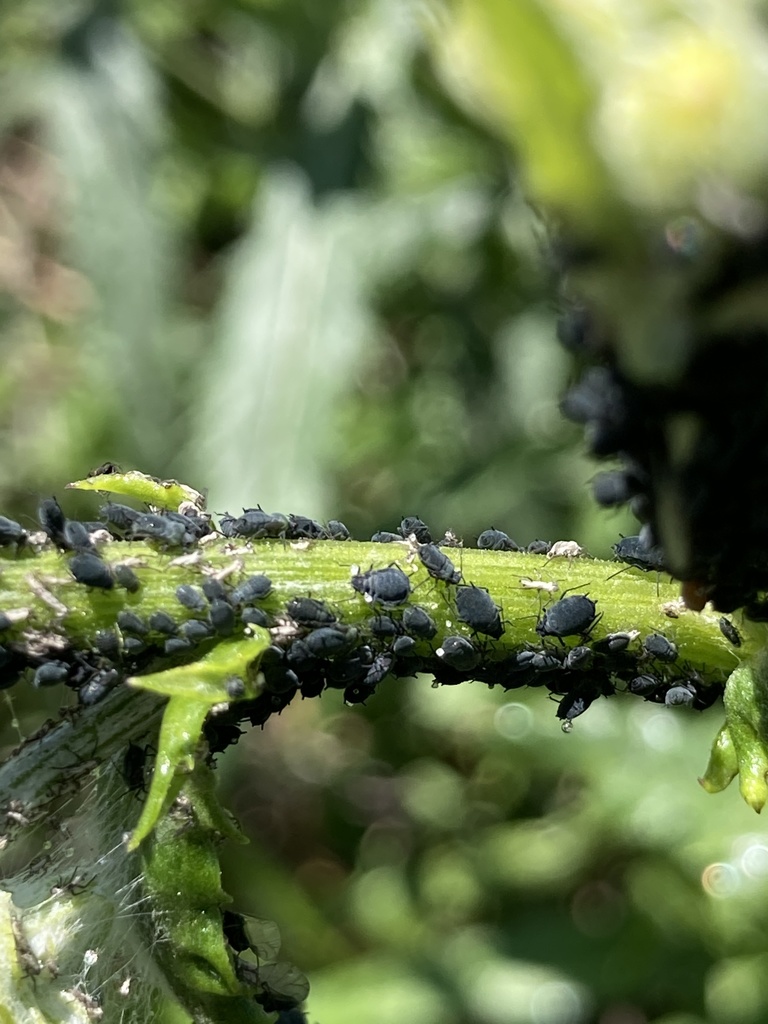
The American ragwort aphid is a relatively large, wingless aphid measuring about 2 mm long and can appear dark yellow-brown, olive or matte black. It lives on Senecio, Erigeron and Packera plants, often in disturbed areas such as roadsides and pastures where these hosts grow abundantly. It is native throughout most of the United States and Canada, extending south into northern Mexico, but it has been introduced to the American Northeast.
Source: Wikipedia
Size
Wingless adults are between 1.9 and 2.8 mm long, making them larger than many other aphids.
Source: Wikipedia
Where it lives
It prefers habitats where its host plants to Senecio, Erigeron and Packera to grow densely. In places like Northland, it is often found on disturbed sites such as roadsides and pastures.
Source: Wikipedia
What it eats
It feeds by sucking sugary sap from the stems, leaves and roots of Senecio, Erigeron and Packera species.
Source: Wikipedia
Life cycle
It lives its whole life on a single group of host plants and does not need a second host to overwinter. In autumn, wingless females produce winged females and males that can mate sexually.
Source: Wikipedia
When you see it
Winged males and egg-laying females are typically seen in October in the Northern Hemisphere.
Source: Wikipedia
Where it comes from
The species occurs naturally across the United States, except the Northeast where it was introduced. Its range extends north into Canada and south into northern Mexico.
Source: Wikipedia
Lookalikes
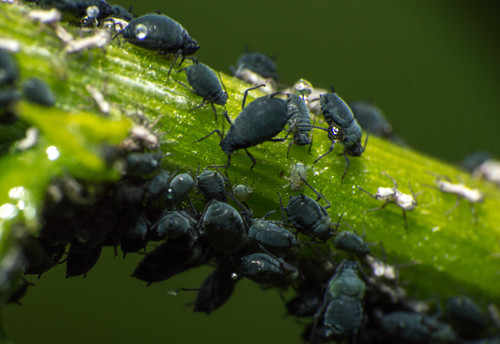
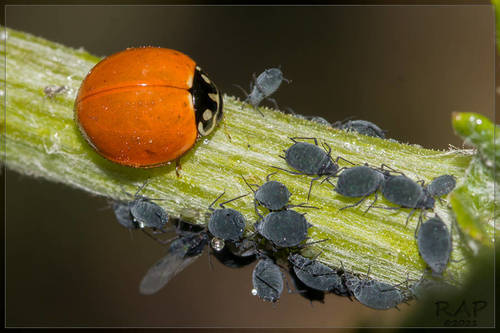
It belongs to a group of dark-coloured aphids that look similar, but can be told apart by its uniformly black legs, unlike Aphis fabae which has lighter tibiae, and by its larger body size compared with Aphis senecionis.
Source: Wikipedia
Where it is found in the US
Recorded in 12 of 51 states and DC. Most records: California, Nebraska, North Carolina, Utah, Oregon, Washington, Colorado, Arizona.
Darker = more records. Counts are museum and citizen-science records, not population size.
Source: GBIF
Months it is reported in the US
Source: GBIF
More photos
Questions people ask
What plants does the American ragwort aphid feed on?
It feeds on the sap of Senecio, Erigeron and Packera species.
Source: Wikipedia
When can I expect to see winged forms of this aphid?
Winged males and egg-laying females appear in October in the Northern Hemisphere.
Source: Wikipedia
How can I tell this aphid apart from similar species?
Look for uniformly black legs and a body length of about 2 mm; other similar aphids have lighter tibiae or are smaller.
Source: Wikipedia
Same family (Aphididae)
 Melon AphidAphis gossypiiDamages trees, gardens or crops
 Oleander AphidAphis neriiDamages trees, gardens or crops
 Witch-hazel Cone Gall AphidHormaphis hamamelidis
 Beech Blight AphidGrylloprociphilus imbricatorDamages trees, gardens or crops
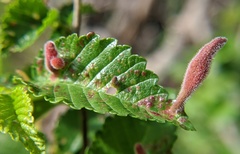 Rice Root AphidTetraneura nigriabdominalis
 Rose AphidMacrosiphum rosaeDamages trees, gardens or crops
Sources
- Wikipedia: https://en.wikipedia.org/wiki/Aphis_lugentis
Look it up elsewhere: GBIF · iNaturalist · BugGuide · Wikipedia
Text written 2026-10-29 from the sources above and checked sentence by sentence against them. Data fetched 2026-10-29.