 Bug FAQ
Yellow-legged Hornet
Vespa velutina · Order: Hymenoptera · Family: Vespidae
Also called: Asian Hornet, Asian Predatory Wasp
Source: Wikipedia, site.extension.uga.edu

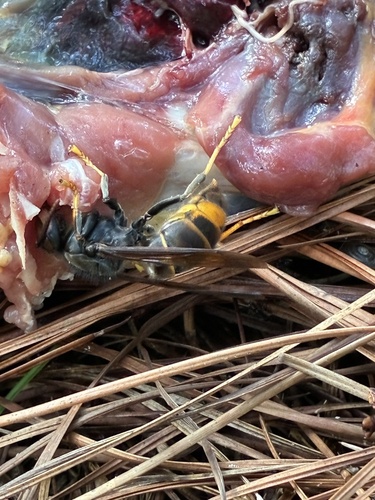
The Yellow-legged Hornet has a velvety brown or black thorax, a brown abdomen, black head, yellow face and yellow tarsi on its legs. Queens reach about 30 mm, males about 24 mm and workers about 20 mm in length. It builds large paper nests above ground, often in trees, that can hold several thousand hornets.
Source: Wikipedia, Penn State Extension, site.extension.uga.edu
How to recognize it
Bald-faced hornets are black and white with entirely black legs, so they look different.
Source: Penn State Extension
Size
Queens are about 30 mm long, males about 24 mm, and workers about 20 mm.
Source: Wikipedia
Is it a pest in the house?
In Europe it is listed as an invasive alien species of Union concern since 2016. It threatens honeybees and other pollinators, and can sting people and pets, especially those allergic.
Source: Wikipedia, site.extension.uga.edu
Does it bite or sting?
Female hornets have strong stingers they use to defend nests and kill prey. Multiple stings have caused anaphylactic shock and hospitalisation in France.
Source: Wikipedia
How to get rid of it
Control efforts focus on locating and destroying nests, especially where the hornet is not yet established. In the UK the public is asked to report sightings via the Asian Hornet Watch app.
Source: Wikipedia
Where it lives
Nests are made of paper, roughly egg-shaped, at least 50 cm long, and are built above ground, often in trees. A single nest can house several thousand hornets.
Source: site.extension.uga.edu, Wikipedia
What it eats
It hunts a wide range of insects such as flies, dragonflies and grasshoppers, catching them by pursuit. It preferentially preys on honey bees, other wasps and flies.
Source: Wikipedia, Penn State Extension
Life cycle
Colonies start in low shrubs, then move to higher trees later in the season.
Source: Wikipedia
When you see it
The nesting season is long, and new queens disperse in late autumn to hibernate over winter.
Source: Wikipedia
Where it is found in the US
Recorded in 2 of 51 states and DC. Most records: South Carolina, Georgia.
Darker = more records. Counts are museum and citizen-science records, not population size.
Source: GBIF
Status: introduced in United States. Source: iNaturalist
Months it is reported in the US
Source: GBIF
More photos


Questions people ask
Are Yellow-legged Hornet stings dangerous?
Yes, stings can cause severe allergic reactions such as anaphylactic shock and may require hospital care.
Source: Wikipedia, site.extension.uga.edu
What should I do if I find a nest?
Contact local pest-control or wildlife authorities to have the nest located and destroyed, especially in areas where the hornet is not yet established.
Source: Wikipedia
Do they damage honeybee colonies?
They prey heavily on honeybees and other pollinators, posing a risk to bee populations.
Same family (Vespidae)


Sources
- Wikipedia: https://en.wikipedia.org/wiki/Asian_hornet
- site.extension.uga.edu: https://site.extension.uga.edu/madison/?p=608
- Penn State Extension: https://extension.psu.edu/yellow-legged-hornet
Look it up elsewhere: GBIF · iNaturalist · BugGuide · Wikipedia
Text written 2026-10-23 from the sources above and checked sentence by sentence against them. Data fetched 2026-10-23.