 Bug FAQ
Eastern Yellowjacket
Vespula maculifrons · Order: Hymenoptera · Family: Vespidae
Source: Wikipedia, hgic.clemson.edu, animaldiversity.org, ask.ifas.ufl.edu

Eastern Yellowjackets are 0.5 to 0.63 in long and weigh about 0.04 g. They build nests underground, in tree stumps, attics, or sometimes aerially, and are common in forests, creek banks, and urban areas (-). They are attracted to sugary foods, meats, and other human foods, and their nests near homes can be a nuisance (-).
Source: Wikipedia, ask.ifas.ufl.edu, hgic.clemson.edu, animaldiversity.org
How to recognize it
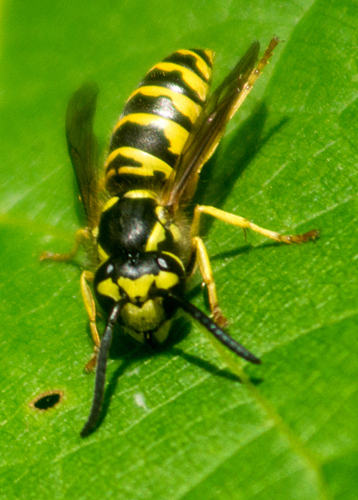
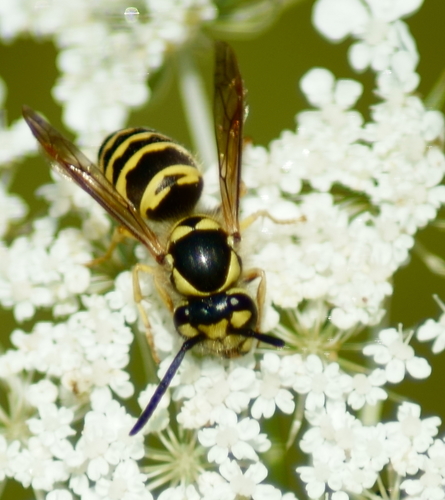
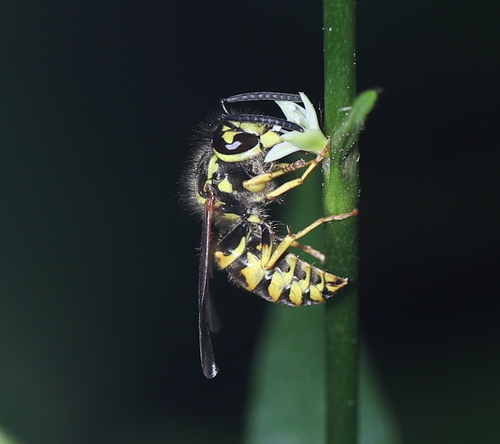
The wasp has black and yellow stripes on the head, thorax, and abdomen. Queens have a broad black band near the thorax followed by thinner black bands toward the rear.
Source: Wikipedia, animaldiversity.org
Is it a pest in the house?
They often nest near homes and can become a source of irritation. Yellowjackets are attracted to carbonated drinks, juices, candy, meat, cakes, fruit, vegetables, and ice cream. Queens may enter houses seeking winter shelter. They can raid beehives in fall to steal honey.
Source: Wikipedia, ask.ifas.ufl.edu, hgic.clemson.edu, animaldiversity.org
Does it bite or sting?
They defend their nests aggressively and can deliver painful stings. Stings are a leading cause of anaphylaxis among hymenopterans. Their smooth stinger can be used repeatedly. Only females have a stinger on the rear of the abdomen.
Source: Wikipedia, ask.ifas.ufl.edu, hgic.clemson.edu, animaldiversity.org
How to get rid of it
For underground nests, enlarge the cavity and drop soil away from the entrance. Apply insecticide at night when foragers are inside the nest. If the nest is large or hard to reach, hire a professional pest-control operator.
Source: Wikipedia, hgic.clemson.edu, ask.ifas.ufl.edu
Where it lives
Nests are usually underground but can also be in tree stumps, attics, or aerial sites (-).
Source: ask.ifas.ufl.edu, Wikipedia
Life cycle
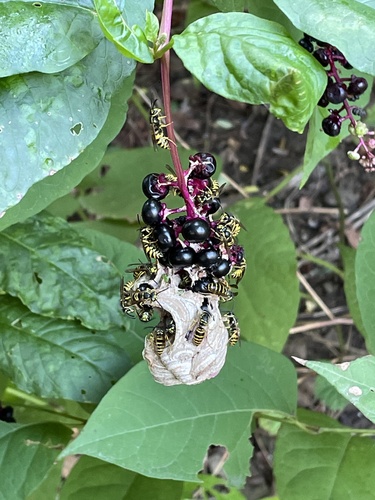
Colonies contain hundreds to thousands of individuals and show typical vespid social structure with queens, workers, and overlapping generations (-).
Source: Wikipedia
When you see it
In spring the queen selects a site for a new colony.
Source: Wikipedia
Where it comes from
The species is native to eastern North America and reaches as far west as the Great Plains (-).
Source: Wikipedia
Lookalikes
Vespula squamosa is a facultative parasite of V. maculifrons and can be distinguished by color patterns. Honey bees are larger, hairy, and have pollen baskets, unlike yellowjackets (-).
Source: Wikipedia, ask.ifas.ufl.edu, hgic.clemson.edu
Where it is found in the US
Recorded in 40 of 51 states and DC. Most records: Virginia, New York, Massachusetts, Ohio, Illinois, North Carolina, Maryland, Pennsylvania.
Darker = more records. Counts are museum and citizen-science records, not population size.
Source: GBIF
Status: native in North America; native in Canada; native in United States. Source: iNaturalist
Months it is reported in the US
Source: GBIF
More photos
Questions people ask
How can I get rid of a yellowjacket nest?
Treat the nest at night with a labeled insecticide or enlarge the entrance and drop soil away, and call a professional if the nest is large or hard to reach.
Source: Wikipedia, hgic.clemson.edu, ask.ifas.ufl.edu
Do Eastern Yellowjackets sting people?
Yes, they can sting repeatedly and the stings can be painful and cause allergic reactions.
Source: Wikipedia, hgic.clemson.edu, ask.ifas.ufl.edu
Where do they build their nests?
Mostly underground, but also in tree stumps, attics, or occasionally aerial sites.
Source: ask.ifas.ufl.edu, Wikipedia
What do they look like?
They have black and yellow stripes on the head, thorax, and abdomen; workers show alternating bands, while queens have a broad black band near the thorax followed by thinner bands.
Source: Wikipedia, hgic.clemson.edu, animaldiversity.org
Same family (Vespidae)


Sources
- Wikipedia: https://en.wikipedia.org/wiki/Eastern_yellowjacket
- hgic.clemson.edu: https://hgic.clemson.edu/factsheet/yellow-jackets/
- animaldiversity.org: https://animaldiversity.org/accounts/Vespula_maculifrons
- ask.ifas.ufl.edu: https://ask.ifas.ufl.edu/publication/IN238
Look it up elsewhere: GBIF · iNaturalist · BugGuide · ITIS · Wikipedia
Text written 2026-10-23 from the sources above and checked sentence by sentence against them. Data fetched 2026-10-23.