 Bug FAQ
Western Yellowjacket
Vespula pensylvanica · Order: Hymenoptera · Family: Vespidae

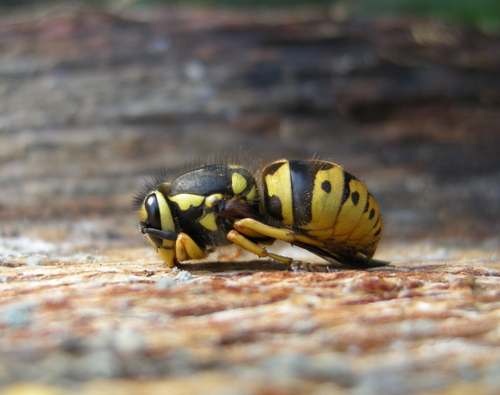
Western yellowjackets are ½-1 inch long with black and yellow stripes and a narrow waist. They build nests underground or in dark cavities such as rodent burrows, old logs, walls or ceilings. They are common pests around garbage, picnics and outdoor food, and can be controlled with traps or nest treatment.
How to recognize it
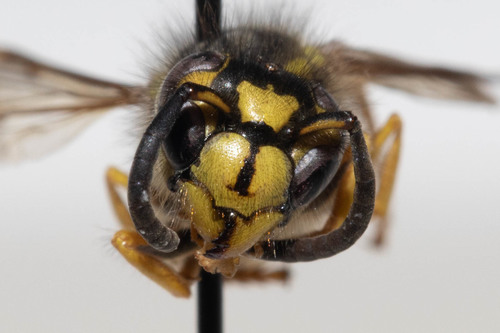
They have the typical yellow-black pattern of Vespula wasps and a continuous yellow ring around each eye.
Source: Wikipedia
Size
Workers have fore-wing lengths of about 8.5 to 10.5 mm, while females and males are 12.5 to 14.5 mm.
Source: Wikipedia
Is it a pest in the house?
They are often a pest to humans, nesting near garbage, parks and resorts. In fall they scavenge at picnics, barbecues, garbage cans and where pet food or ripe fruit is left.
Does it bite or sting?
Sting treatment includes antihistamine ointments or tablets to reduce reactions. When they crawl into soda cans at outdoor meals they can sting the lips or throat.
How to get rid of it
Because disturbing a colony can cause many stings, control is recommended during outbreaks. Monitoring and control use traps with synthetic attractants and tree shaking. If treating a nest yourself, wear protective clothing and use a labeled insecticide that sprays a long stream into the entrance.
Where it lives
They are found in open forests, prairies, urban areas, gardens, parks, meadows and houses.
Source: Wikipedia
What it eats
They scavenge on garbage and food waste, especially around human activity.
Source: Wikipedia
Life cycle
Colonies are usually annual and monogynous, but in Hawaii they can be polygynous and overwinter.
Source: Wikipedia
When you see it
Cold weather limits their reproduction, reducing numbers in colder months. Outbreaks can cause financial problems for logging, fruit growers and recreation.
Source: Wikipedia
Lookalikes
They are often mistaken for V. germanica; the eye-loop and frons spot help tell them apart. Honey bees have less bright striping and more hair than yellowjackets.
Where it is found in the US
Recorded in 21 of 51 states and DC. Most records: California, Washington, Colorado, Oregon, Utah, Idaho, Arizona, New Mexico.
Darker = more records. Counts are museum and citizen-science records, not population size.
Source: GBIF
Status: native in North America; native in United States; native in Canada. Source: iNaturalist
Months it is reported in the US
Source: GBIF
More photos
Questions people ask
How can I safely remove a western yellowjacket nest?
Wear full protective clothing and spray a long-stream insecticide into the nest entrance, or use traps with chemical attractants.
Why are yellowjackets showing up at my picnic?
In fall they scavenge for food and are attracted to garbage, pet food, and ripe fruit left outdoors.
Source: UC IPM
Same family (Vespidae)


Sources
- Wikipedia: https://en.wikipedia.org/wiki/Vespula_pensylvanica
- UC IPM: https://ipm.ucanr.edu/PMG/PESTNOTES/pn7450.html
Look it up elsewhere: GBIF · iNaturalist · BugGuide · ITIS · Wikipedia
Text written 2026-10-23 from the sources above and checked sentence by sentence against them. Data fetched 2026-10-23.