 Bug FAQ
German Yellowjacket
Vespula germanica · Order: Hymenoptera · Family: Vespidae
Also called: European Wasp, German Wasp
Source: UC IPM

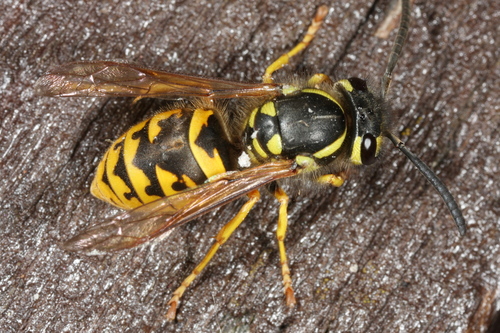
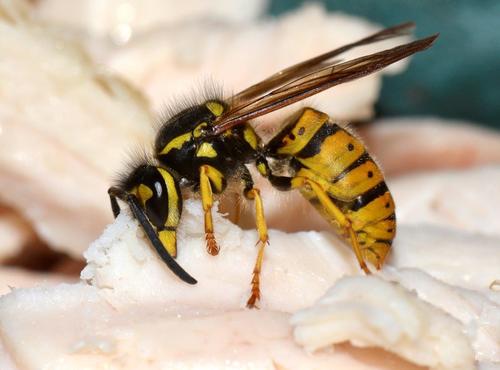
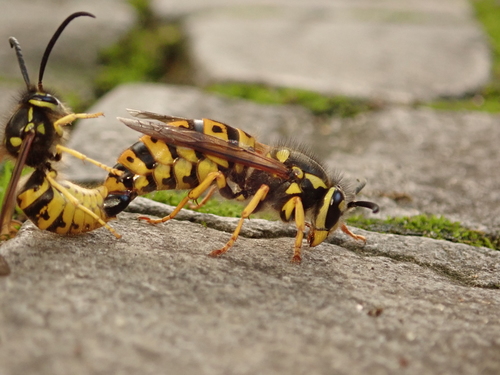
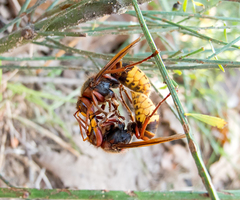
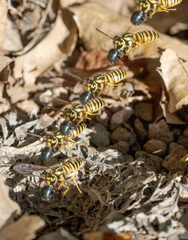
They are about half an inch long with bright yellow and black stripes and a barely visible narrow waist. Nests are usually underground but many are found in attics, walls, or other cavities in houses. They eat carrion, live insects, fruit, honeydew and human food waste, and they can be aggressive when scavenging at picnics.
How to recognize it
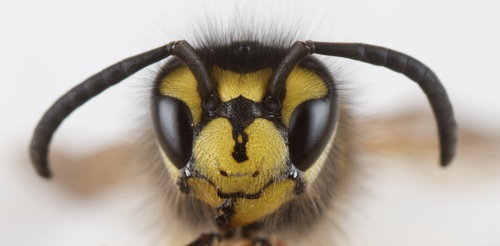
Look for three tiny black dots on the face (clypeus) to tell it apart from the common wasp. The yellow and black stripes are jagged and the waist is very narrow.
Size
Adults are about 13 mm (0.5 in) long.
Source: Wikipedia
Is it a pest in the house?
They are invasive and often become pests in new areas, especially when nesting in homes.
Source: Wikipedia
Does it bite or sting?
They are more likely to sting if they are disturbed while foraging. When feeding at outdoor meals they may crawl into cans and sting the lips or throat.
Source: UC IPM
How to get rid of it
Traps can help reduce their numbers. If treating a nest yourself, wear full protective clothing and use a labeled insecticide that sprays a long stream into the entrance.
Source: UC IPM
Where it lives
Most nests are built in soil below ground. A good number are built in attics, walls, or other artificial structures.
What it eats
They scavenge carrion, live arthropods, fruit, honeydew and human food waste.
Source: Wikipedia
Life cycle
A single queen starts a nest in spring with a small cluster of hexagonal cells. The colony expands quickly in summer, producing many workers and a larger nest.
Source: Wikipedia
When you see it
Growth slows by late summer and more males are produced than workers.
Source: Wikipedia
Where it comes from
They originated in Europe, Asia and North Africa.
Source: Wikipedia
Lookalikes
They look very similar to the common wasp, which can sometimes have a broken black mark on the face. Honey bees have less bright striping and more hair than yellowjackets.
Where it is found in the US
Recorded in 42 of 51 states and DC. Most records: New York, Pennsylvania, Ohio, Massachusetts, Illinois, Michigan, Minnesota, Wisconsin.
Darker = more records. Counts are museum and citizen-science records, not population size.
Source: GBIF
Status: introduced in North America; introduced in United States; introduced in Canada. Source: iNaturalist
Months it is reported in the US
Source: GBIF
More photos
Questions people ask
Do German yellowjackets bite or sting?
They can sting, especially if disturbed while foraging, and may sting inside the mouth if they crawl into food containers.
Source: UC IPM
How can I tell a German yellowjacket from a common wasp?
Look for three tiny black dots on the face; common wasps usually have a solid black mark that may appear broken in males.
Source: Wikipedia
Where do they build their nests?
Mostly underground, but many nests are found in attics, walls, or other cavities in buildings.
Are they a pest in homes?
Yes, they are invasive and often nest in houses, making them a household pest.
Source: Wikipedia
Same family (Vespidae)


Sources
- UC IPM: https://ipm.ucanr.edu/PMG/PESTNOTES/pn7450.html
- Wikipedia: https://en.wikipedia.org/wiki/Vespula_germanica
Look it up elsewhere: GBIF · iNaturalist · BugGuide · ITIS · Wikipedia
Text written 2026-10-22 from the sources above and checked sentence by sentence against them. Data fetched 2026-10-22.