 Bug FAQ
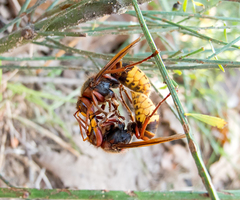
Yellow Hornet
Vespa simillima · Order: Hymenoptera · Family: Vespidae
Also called: Vespid wasp

It builds nests in many places, from attics and wall cavities in houses to hollow trees, underground holes and rock walls in nature.
Source: Wikipedia
Is it a pest in the house?
Nests are often found in attics, under eaves, inside walls or ventilation openings of buildings. They are highly adaptable, using open or enclosed sites and can relocate colonies mid-season.
Source: Wikipedia
Where it lives
In human structures they nest in attics, under eaves, inside walls or ventilation holes. In the wild they use hollow trees, underground cavities, rock walls and bushes for nests.
Source: Wikipedia
What it eats
Adults drink sugary liquids such as tree sap, flower nectar, fruit juices and even discarded candy. They hunt a wide range of insects and spiders for protein, recorded from over 40 species in eight orders.
Source: Wikipedia
Life cycle
A colony is started by a single queen, like all Vespa species. Eggs develop into adults in about 31 days on average. Worker hornets typically survive about 13 days once they emerge.
Source: Wikipedia
When you see it
They can nest in many different sites, both above and below ground, and can move the colony during the nesting period.
Source: Wikipedia
Status: introduced in Canada. Source: iNaturalist
More photos


Questions people ask
Where do yellow hornets build their nests?
They nest in attics, under eaves, inside walls or ventilation holes of houses, and in hollow trees, underground cavities, rock walls and bushes outdoors.
Source: Wikipedia
What do yellow hornets eat?
Adults sip sugary liquids like tree sap, flower nectar, fruit juices and candy, and they hunt insects and spiders for protein.
Source: Wikipedia
How long does it take for a yellow hornet to become an adult?
The development from egg to adult takes about 31 days on average.
Source: Wikipedia
Same family (Vespidae)


Sources
- Wikipedia: https://en.wikipedia.org/wiki/Vespa_simillima
Look it up elsewhere: GBIF · iNaturalist · BugGuide · Wikipedia
Text written 2026-10-23 from the sources above and checked sentence by sentence against them. Data fetched 2026-10-23.