 Bug FAQ
Yellow-faced Fly
Tachina grossa · Order: Diptera · Family: Tachinidae
Also called: giant tachinid fly

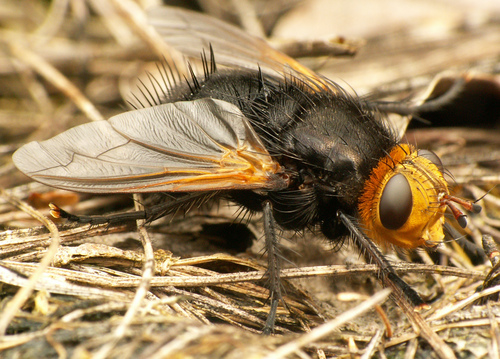
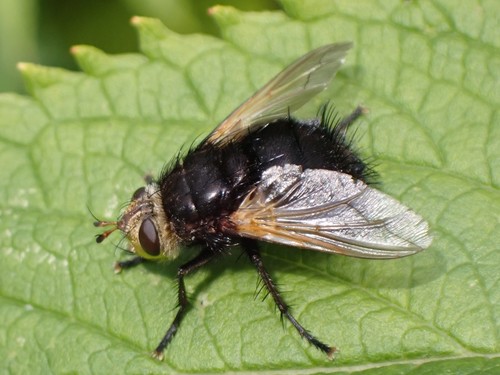
The yellow-faced fly is a large, hairy tachinid about 15 to 19 mm long, with a black body and a bright yellow head with yellow bristles. It lives in dry open meadows, moors, forests, heaths and gardens across most of Western Europe to Mongolia, and adults feed on flower nectar and pollen.
Source: Wikipedia
How to recognize it
The fly is very hairy, with a black thorax and abdomen, and a bright yellow head bearing yellow occipital bristles.
Source: Wikipedia
Size
Adults reach 15 to 19 mm (0.6 to 0.7 in) in length, making them one of the largest tachinids in Europe.
Source: Wikipedia
Where it lives
It is found in dry open meadows, peat lands, moors, forests, heaths and gardens.
Source: Wikipedia
What it eats
Adults feed on nectar and pollen from flowers. Females lay eggs on living insect larvae; the developing fly larvae eat the host from inside, eventually killing it.
Source: Wikipedia
Life cycle
In the UK there is usually one generation per year, while southern Europe may have two generations per summer season.
Source: Wikipedia
When you see it
Adults are on the wing from late June to early September.
Source: Wikipedia
Where it comes from
Its range covers most of Western Europe, extends eastward into Asia, and reaches Mongolia.
Source: Wikipedia
Lookalikes
When flying they can be mistaken for a bumblebee.
Source: Wikipedia
Where it is found in the US
Recorded in 2 of 51 states and DC. Most records: Wyoming, Colorado.
Darker = more records. Counts are museum and citizen-science records, not population size.
Source: GBIF
More photos
Same family (Tachinidae)




Sources
- Wikipedia: https://en.wikipedia.org/wiki/Tachina_grossa
Look it up elsewhere: GBIF · iNaturalist · BugGuide · Wikipedia
Text written 2026-10-23 from the sources above and checked sentence by sentence against them. Data fetched 2026-10-22.