 Bug FAQ
Cylindromyia bicolor
Cylindromyia bicolor · Order: Diptera · Family: Tachinidae
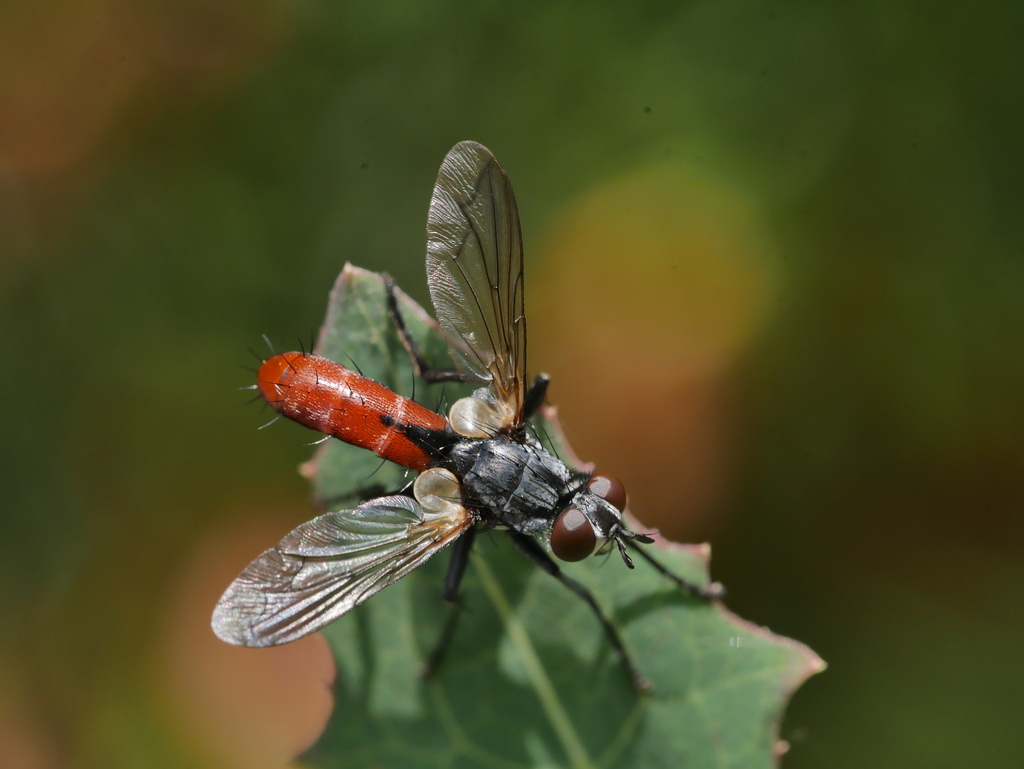
Cylindromyia bicolor is a small European tachinid fly about 11 to 14 mm long. It has a gray thorax, a long red abdomen with a black band at the base, dark brown eyes, partly smoked wings and large white calyptra. Adults appear from mid-July to October, most commonly in August, and are found in dry meadows, bushes, woodland edges, marshes, parks and gardens.
Source: Wikipedia
How to recognize it
The fly shows a grayish thorax, an elongated red abdomen with a black basal band, dark brown compound eyes, partly smoked wings, large white calyptra and black legs.
Source: Wikipedia
Size
It reaches a length of 11 to 14 mm (0.43 to 0.55 in).
Source: Wikipedia
Where it lives
It lives in dry meadows, bushes, woodland edges, marshes, parks and gardens.
Source: Wikipedia
Life cycle
Females lay a single egg on a host bug; the larva enters the juvenile pentatomid’s abdomen, develops there, and pupates on the ground after winter.
Source: Wikipedia
When you see it
Adults are present from mid-July through October, peaking in August.
Source: Wikipedia
Where it comes from
It is a European species of the family Tachinidae.
Source: Wikipedia
More photos
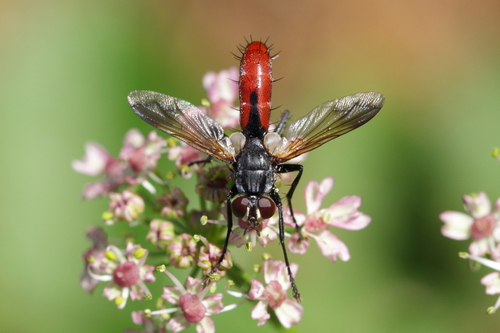

Same family (Tachinidae)




Sources
- Wikipedia: https://en.wikipedia.org/wiki/Cylindromyia_bicolor
Look it up elsewhere: GBIF · iNaturalist · BugGuide · Wikipedia
Text written 2026-10-23 from the sources above and checked sentence by sentence against them. Data fetched 2026-10-22.