 Bug FAQ
Common Tachinid
Tachina fera · Order: Diptera · Family: Tachinidae
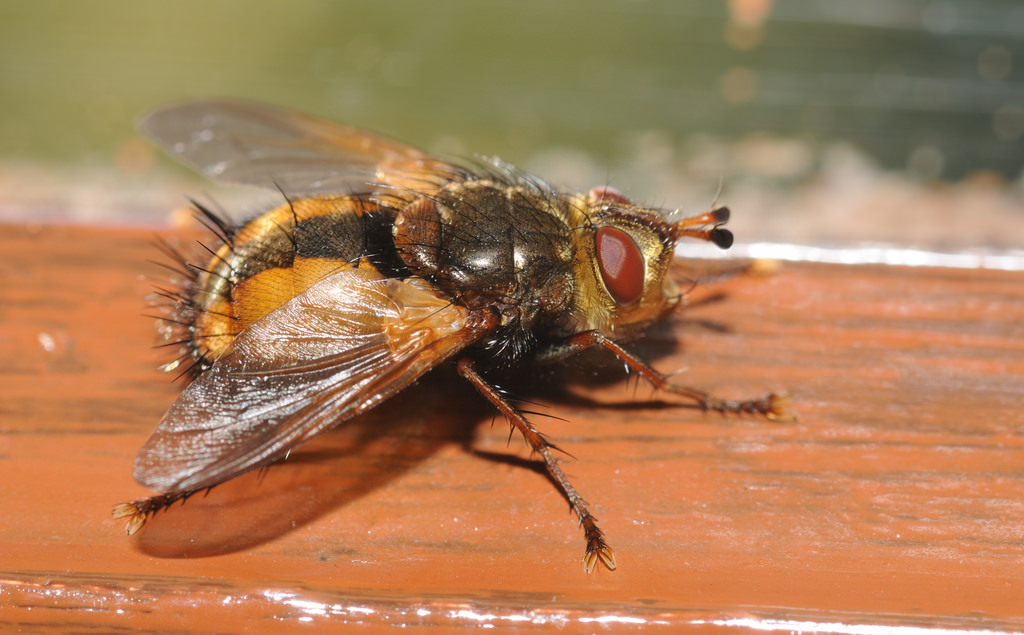
The common tachinid is a 9 to 14 mm fly with a gray thorax, orange-red postscutellum, and a yellow-orange abdomen marked by a black stripe that ends in a point. It lives in humid meadows, woods, heath, and gardens across most of Europe, parts of Asia, North Africa and Israel, and is seen from April to October in two generations per year. Adults feed on flower nectar and pollen, while their larvae are parasitoids of moth caterpillars.
Source: Wikipedia
How to recognize it
The thorax is grayish with dense dusting and regular black stripes. Near the thorax there is a shiny orange-red bump called the postscutellum, edged in thin black. The head is yellowish; the second antennal segment is yellow and the short third segment is black.
Source: Wikipedia
Size
Adults measure 9 to 14 mm in length with a wingspan of 16 to 27 mm.
Source: Wikipedia
Where it lives
They are found on vegetation in humid areas such as meadows, woodlands, forest edges, clearings, heath, moorland, and natural gardens.
Source: Wikipedia
What it eats
Adults sip nectar and pollen, especially from thistles (Asteraceae) and hogweed (Apiaceae). Larvae are internal parasites of other insects, mainly moth caterpillars in the Noctuidae and Lymantriidae families.
Source: Wikipedia
Life cycle
The species has two generations each year. After leaving the host, pupae develop in soil litter and emerge as adults after about two weeks.
Source: Wikipedia
When you see it
Adults appear from late April to late June and again from mid-July to mid-October.
Source: Wikipedia
Where it comes from
Their range covers the whole Palearctic region, from Scandinavia and European Russia through Israel, North Asia to China, Mongolia, Korea, Japan, and also North Africa.
Source: Wikipedia
Lookalikes
It resembles Tachina magnicornis, which is slightly smaller, has a dorsal band forming lozenges, and lacks the pointed stripe tip.
Source: Wikipedia
More photos

Questions people ask
When can I expect to see them?
You’ll see adults from late April through late June and again from mid-July to mid-October.
Source: Wikipedia
Same family (Tachinidae)



Sources
- Wikipedia: https://en.wikipedia.org/wiki/Tachina_fera
Look it up elsewhere: GBIF · iNaturalist · BugGuide · Wikipedia
Text written 2026-10-22 from the sources above and checked sentence by sentence against them. Data fetched 2026-10-22.