 Bug FAQ
Swift Feather-legged Fly
Trichopoda pennipes · Order: Diptera · Family: Tachinidae
Also called: Tachinid Fly

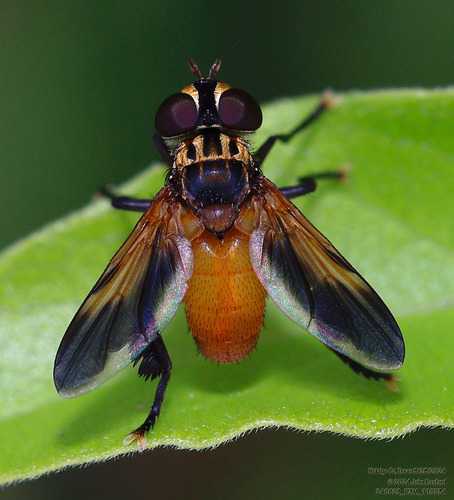
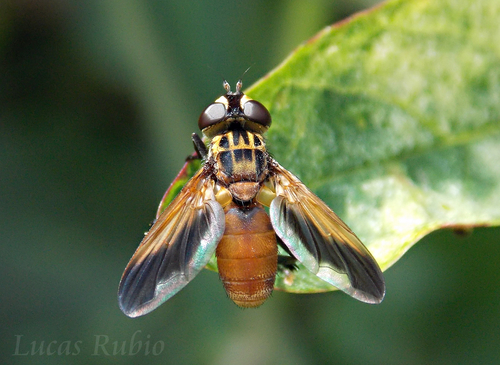
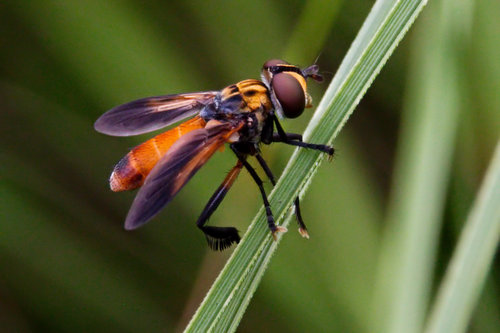
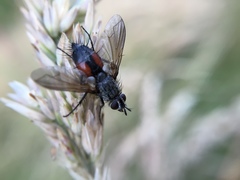
Adult flies are about the size of a large housefly with a velvety black head, a striped thorax and a slender abdomen that can be orange to black. Males have a rust-colored spot on their transparent, smoky wings and the hind legs have a fringe of feather-like hairs.
Source: Wikipedia
How to recognize it
The head is velvety and black, while the thorax is black or brown with a few yellow stripes. Eyes are large, brown with yellow between them. Legs are black with yellow feet, and the hind legs bear a prominent fringe of flattened hairs. Wings are transparent and smoky with prominent veins; males show a ferrugineous (rust-colored) marking on the wings.
Source: Wikipedia
Size
Adults grow to about 10.5 mm (0.41 in) long, roughly the size of a large housefly.
Source: Wikipedia
Where it lives
They live in grasslands, hedge rows and crop fields where their bug hosts are present.
Source: Wikipedia
What it eats
Larvae are parasitoids of true bugs, especially squash bugs, leaf-footed bugs, stinkbugs and related families.
Source: Wikipedia
Life cycle
After about two weeks in the pupa, an adult emerges. There can be up to three generations per year, and the fly overwinters as a second-instar larva inside its host.
Source: Wikipedia
When you see it
Adults first appear in late spring or early summer.
Source: Wikipedia
Where it comes from
The species is native to North America, the Hawaiian Islands and South America.
Source: Wikipedia
Lookalikes
It belongs to the feather-legged flies in the tachinid family.
Source: Wikipedia
Where it is found in the US
Recorded in 45 of 51 states and DC. Most records: Texas, Virginia, Ohio, Pennsylvania, Massachusetts, New York, Maryland, North Carolina.
Darker = more records. Counts are museum and citizen-science records, not population size.
Source: GBIF
Status: native in North America; native in Canada. Source: iNaturalist
Months it is reported in the US
Source: GBIF
More photos

Questions people ask
Are they a garden pest?
No, the larvae actually parasitize pest bugs such as squash bugs and stinkbugs.
Source: Wikipedia
How can I tell a male from a female?
Males have a rust-colored spot on their wings, which females lack.
Source: Wikipedia
Same family (Tachinidae)



Sources
- Wikipedia: https://en.wikipedia.org/wiki/Trichopoda_pennipes
Look it up elsewhere: GBIF · iNaturalist · BugGuide · ITIS · Wikipedia
Text written 2026-10-22 from the sources above and checked sentence by sentence against them. Data fetched 2026-10-22.