 Bug FAQ
Western Willow Spreadwing
Chalcolestes viridis · Order: Odonata · Family: Lestidae
Also called: Green Emerald Damselfly, Willow Emerald Damselfly

The Western Willow Spreadwing is a metallic-green damselfly that rests with its wings spread apart and has a pale-brown pterostigma edged in black. It lives near still or slow-moving water with overhanging willows, alders or birches, where it lays eggs in bark incisions that develop quickly before entering a slow-growing overwintering stage. Adults fly from late summer into autumn, can be seen as early as May in the south, and are often found perched in bushes beside water.
Source: Wikipedia
How to recognize it
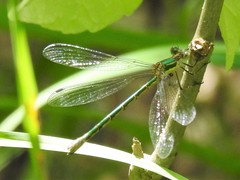
It has a metallic green body and holds its wings open when at rest. The wing spot (pterostigma) is pale brown with a black outline.
Source: Wikipedia
Life cycle
Eggs develop quickly for a few weeks, then enter a diapause where development slows and they overwinter.
Source: Wikipedia
When you see it
Flight time runs from late August to October, but in the southern range it may start in May and continue to November.
Source: Wikipedia
Where it comes from
It is native to southern and central Europe and North Africa.
Source: Wikipedia
Lookalikes
In the field it cannot be reliably separated from C. parvidens; both are larger, darker metallic-green damselflies without the powder-blue bloom seen in other Lestes species.
Source: Wikipedia
More photos
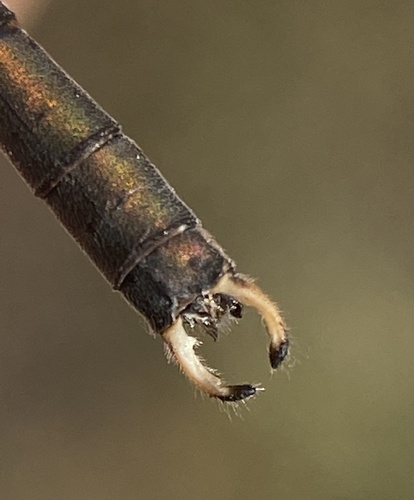
Same family (Lestidae)
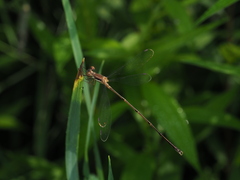
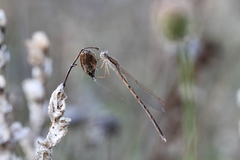
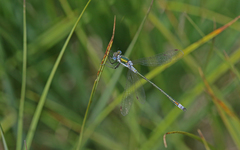
Sources
- Wikipedia: https://en.wikipedia.org/wiki/Chalcolestes_viridis
Look it up elsewhere: GBIF · iNaturalist · BugGuide · Wikipedia
Text written 2026-10-22 from the sources above and checked sentence by sentence against them. Data fetched 2026-10-22.