 Bug FAQ
Emerald Spreadwing
Lestes dryas · Order: Odonata · Family: Lestidae
Also called: Robust Spreadwing, Scarce Spreadwing, Turlough Spreadwing
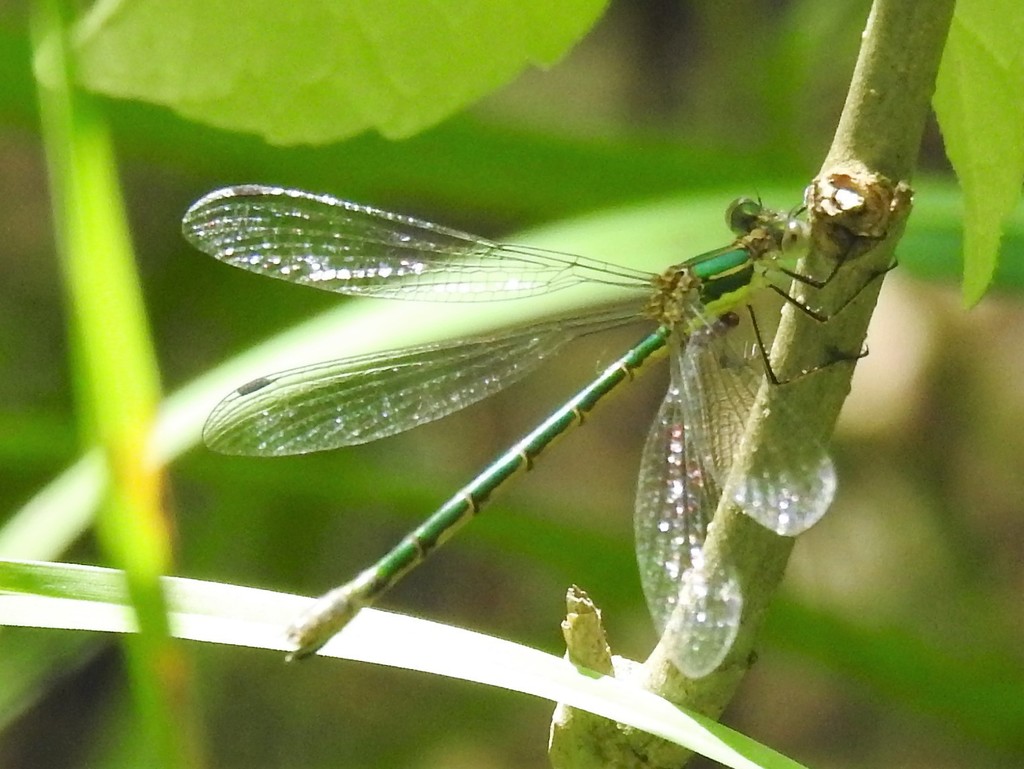
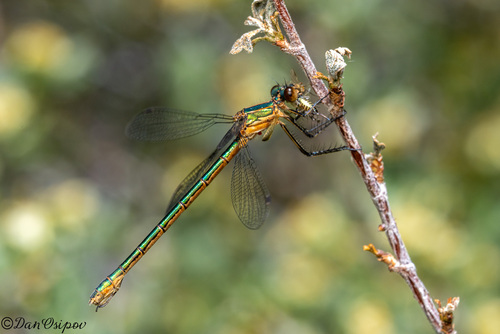
The emerald spreadwing is a metallic-green damselfly about 35 to 42 mm long, with males slightly larger than females and a wingspan around 45 to 47 mm. It lives around still, shallow water such as ponds, ditches, bogs and even slightly brackish coastal sites, and is found across the Holarctic region. Adults appear from April to August, develop a powder-blue pruinescence in midsummer, and lay elongated eggs in plant stems that become submerged as water rises.
Source: Wikipedia
How to recognize it
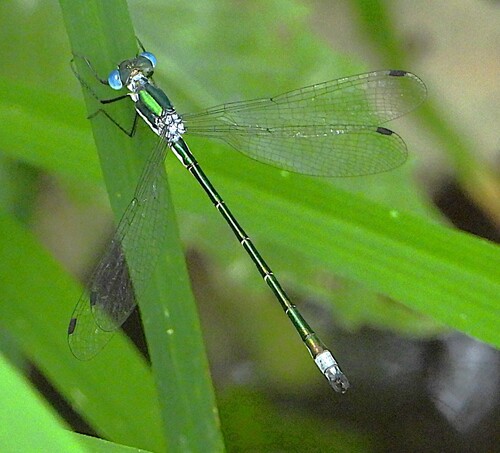
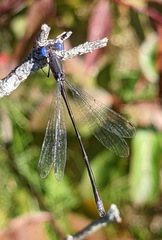
Both sexes have a metallic green body with a bronze shine; males have blue eyes and develop a powder-blue bloom as they age.
Source: Wikipedia
Size
Body length ranges from 35 to 42 mm, males being the longer sex. Male wingspan is about 45 mm, female about 47 mm.
Source: Wikipedia
Where it lives
Found in still, shallow, well-vegetated water bodies such as ditches, ponds, bogs and lakes. Can also inhabit slightly brackish water near coasts.
Source: Wikipedia
What it eats
Larvae are active hunters that grow quickly by eating prey. The first larval stage (prolarva) cannot feed and moves until it finds water.
Source: Wikipedia
Life cycle
Females lay elongated eggs above water into plant stems, which become submerged as water rises. The number of larval stages varies; under good conditions the final stage can be reached in about eight weeks.
Source: Wikipedia
When you see it
Adults are on the wing from April in the south to late May in the north, with peak activity in July and August. Blue pruinescence appears during the midsummer flight period.
Source: Wikipedia
Where it comes from
Native to the Holarctic, especially northern Eurasia and North America, with relict populations in North Africa.
Source: Wikipedia
Lookalikes
It closely resembles the emerald damselfly Lestes sponsa; identification relies on the shape and colour of the anal appendages.
Source: Wikipedia
Where it is found in the US
Recorded in 33 of 51 states and DC. Most records: Michigan, Ohio, California, Oregon, Colorado, Illinois, Wisconsin, Utah.
Darker = more records. Counts are museum and citizen-science records, not population size.
Source: GBIF
Status: native in North America; native in Canada; native in United States. Source: iNaturalist
Months it is reported in the US
Source: GBIF
More photos
Questions people ask
How can I tell an emerald spreadwing apart from similar damselflies?
Look at the anal appendage shape and colour; this feature distinguishes it from other Lestes species.
Source: Wikipedia
Same family (Lestidae)

Sources
- Wikipedia: https://en.wikipedia.org/wiki/Lestes_dryas
Look it up elsewhere: GBIF · iNaturalist · BugGuide · ITIS · Wikipedia
Text written 2026-10-22 from the sources above and checked sentence by sentence against them. Data fetched 2026-10-22.