 Bug FAQ
Western Spotted Orbweaver
Neoscona oaxacensis · Order: Araneae · Family: Araneidae
Also called: Zig-zag spider, orb weavers
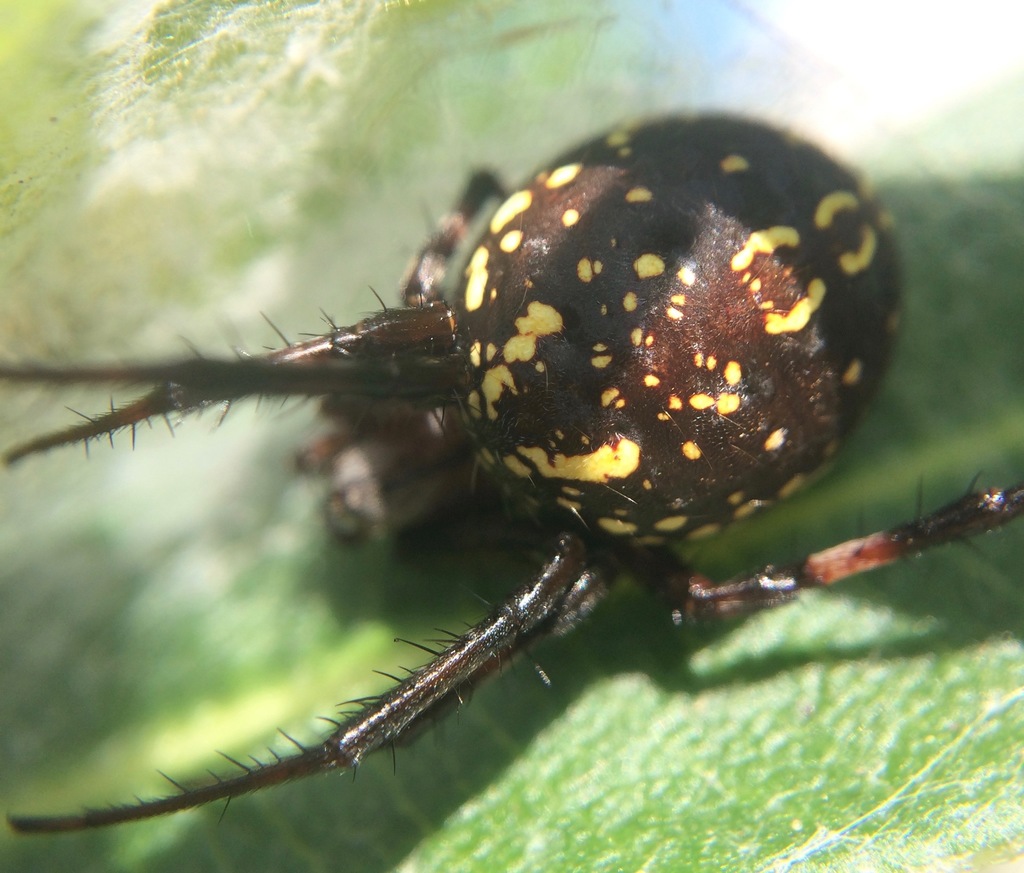
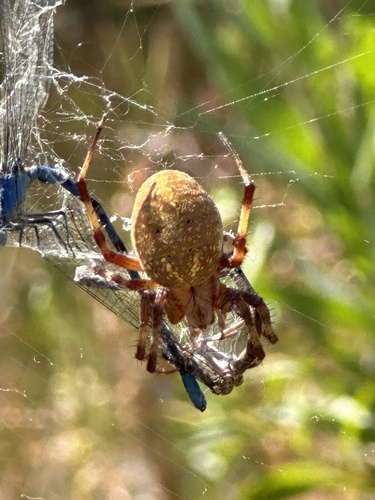
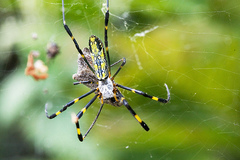
The Western Spotted Orbweaver is a relatively large spider, with females 9 to 18 mm long and males 6 to 13 mm long. It has a distinctive black-and-white pattern on the upper abdomen, and South American specimens show a slimmer abdomen with a wavy light central band. Its range covers the western United States, Mexico, Central America down to Costa Rica, and occasional records from northern South America and the Galápagos.
Source: Wikipedia
How to recognize it
The spider’s dorsal abdomen displays a striking black-and-white pattern that helps identify it. Specimens from South America have a more slender abdomen with a distinct wavy-bordered light central band.
Source: Wikipedia
Size
Females measure about 9 to 18 mm in total length, with a carapace 4 to 8 mm long and 3 to 6 mm wide. Males are smaller, about 6 to 13 mm long overall, with a carapace 3 to 6 mm long and 3 to 5 mm wide.
Source: Wikipedia
Where it comes from
It is widespread across the western United States, Mexico, Central America to Costa Rica, with occasional records in Colombia, Venezuela, Ecuador, Peru, and the Galápagos Islands.
Source: Wikipedia
Where it is found in the US
Recorded in 18 of 51 states and DC. Most records: California, Texas, Utah, Arizona, New Mexico, Washington, Idaho, Nevada.
Darker = more records. Counts are museum and citizen-science records, not population size.
Source: GBIF
Status: native in North America; native in United States. Source: iNaturalist
Months it is reported in the US
Source: GBIF
More photos
Same family (Araneidae)


Sources
- Wikipedia: https://en.wikipedia.org/wiki/Neoscona_oaxacensis
Look it up elsewhere: GBIF · iNaturalist · BugGuide · ITIS · Wikipedia
Text written 2026-10-22 from the sources above and checked sentence by sentence against them. Data fetched 2026-10-22.